
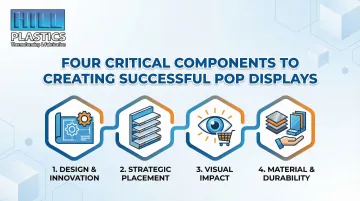
This scenario plays out in retail environments every day. 72% of shoppers make unplanned purchases based on in-store messaging, which means the presence—or absence—of a well-executed POP display directly impacts your bottom line. But here's the catch: a successful POP display isn't just about creating an attractive design. It depends on four interdependent components that must each be executed correctly: design, assembly, fulfillment, and distribution. Overlook any one of them, and your investment never delivers a return.
This article breaks down each component, explains what goes wrong when one is neglected, and shows you how to coordinate all four into a unified program that drives real sales lift.
Key Takeaways
- POP displays capture shopper attention at the moment of purchase, driving impulse buys that standard shelf placement can't reach
- Success depends on four critical components—design, assembly, fulfillment, and distribution—each affecting the others
- Design sets every downstream decision: retailer compliance, visual impact, material choice, and shipping method
- Assembly and fulfillment require space, labor, and quality control planning to avoid costly bottlenecks and rework
- Distribution timing determines ROI: displays that arrive late or damaged represent wasted investment
What Are POP Displays and Why Do They Matter?
Point-of-purchase (POP) displays are branded retail structures placed in high-traffic, strategic store locations—separate from standard shelf placement—designed to increase product visibility and trigger impulse purchases. Unlike permanent shelf fixtures, POP displays are temporary or semi-permanent marketing tools positioned in end caps, checkout lanes, aisle floors, or countertops to intercept shoppers at the moment they're making buying decisions.
The competitive edge they provide is measurable. 72% of shoppers make unplanned purchases based on in-store messaging, and the average consumer spends just 13 seconds purchasing a brand in-store. In that narrow window, a well-placed display can capture attention, communicate value, and convert a browser into a buyer.
But when execution fails, the consequences are immediate. Common failure points include:
- Failed compliance reviews — displays rejected by retailers never reach the sales floor
- Damage in transit — units that arrive broken sit in distribution centers while the promotional window closes
- Assembly abandonment — up to 40% of POP programs are never assembled in-store, turning production spend into pure waste
Every dollar invested in design, materials, and production is lost when any single link in the chain breaks down.
Component 1: Design — The Foundation of Every Successful POP Display
Design is the first and most consequential component because every decision that follows—material sourcing, assembly workflow, packaging method, shipping carrier—flows directly from it. A poorly planned design creates bottlenecks and failures throughout the entire program.
Retailer Compliance: The Non-Negotiable Starting Point
Before you finalize any design, you must research and adhere to specific retailer guidelines. These requirements cover dimensions, weight limits, sight line restrictions, and structural attachment methods. Non-compliant displays are rejected before they ever reach the sales floor, no matter how visually compelling they are.
Compliance rules vary by retailer:
- Walmart: Palletized displays require a minimum 200# Mullen board grade, and maximum pallet height is 96 inches
- Kroger: Quarter pallet displays have a maximum height of 60 inches (including pallet and header) and maximum dimensions of 24 inches left-to-right by 20 inches front-to-back
- Target: Dieline specs generally mandate a maximum height of 54 inches with strict width tolerances to fit standard 36-inch gondola endcaps
Designing without these constraints in mind guarantees rejection and wasted production investment.
Visual Impact and the 5-Second Rule
Shoppers make snap decisions in seconds. The average consumer spends 13 seconds purchasing a brand in-store, and during unplanned purchases, products are fixated on for just 0.6 seconds. Your display must communicate three things at a glance: what the product is, why it's different, and where to find pricing.
Key design elements that drive this instant communication:
- Color contrast: High contrast (minimum 65%) between text and background improves readability and attention capture
- Visual hierarchy: Products positioned at chest level (approximately 14.7 inches below eye level) receive the most attention
- Brand messaging: Clear, bold typography and recognizable brand imagery reduce cognitive load and speed decision-making
- Placement strategy: Shoppers pay more attention to products on their right side when moving through an aisle
The goal isn't just aesthetic appeal—it's functional communication under time pressure.
Material Selection and Its Downstream Impact
The materials you choose directly affect durability, cost, production method, and shipping logistics. The three primary material categories are:
| Material Type | Use Case | Typical Lifespan |
|---|---|---|
| Corrugated Cardboard | Temporary/seasonal displays | 4-12 weeks |
| Metal Framing | Semi-permanent structural support | 3-12 months |
| Thermoformed Plastic | Permanent, high-detail components | 1-5+ years |
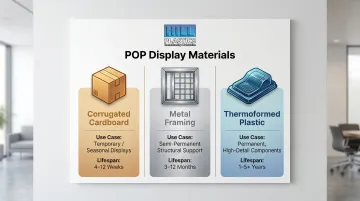
Corrugated is cost-effective for short promotional windows but doesn't support heavy products or long-term use. Metal provides structural support and load-bearing capacity for permanent fixtures. Thermoformed plastic is increasingly chosen for permanent and semi-permanent displays where structural integrity, precise fit, and consistent brand appearance matter most.
Thermoformed components, like those produced by Hill Plastics, offer clean surfaces with high detail reproduction, better moisture resistance than paper, and the durability to hold up through months of retail use.
Design Must Account for Shipping
Whether your display ships fully assembled on pallets or as a flat-pack kit directly affects the structural design. Packaging and transit stresses must be factored in at the design stage, not retrofitted afterward.
Fully assembled displays require reinforced structural support to withstand pallet stacking and LTL freight handling. Flat-pack designs need interlocking tabs, clear assembly instructions, and parts that nest efficiently to minimize cube and shipping costs.
Hill Plastics' design and engineering team works with clients to ensure thermoformed components are built with shipping in mind from the start, whether that means parts that stack cleanly or structural elements engineered to survive transit without damage.
Ignoring shipping constraints at the design phase leads to damaged displays, increased freight costs, and missed launch windows.
Component 2: Assembly — Turning a Design into a Physical Reality
Assembly is where design becomes a tangible structure, and where two recurring operational challenges—space and labor—most often create bottlenecks for brands attempting to handle this in-house.
Space Constraints
Manufacturing and distribution facilities rarely have dedicated, flexible floor space for display assembly at scale. Assembly operations require staging areas for components, workstations for assembly lines, and finished goods storage—all of which compete with core warehouse functions.
Many brands outsource assembly to contract packers who can allocate and reconfigure production lines based on project volume. These partners maintain dedicated assembly space and can scale operations up or down without disrupting the brand's primary distribution activities.
Space is only half the problem. The other variable — labor — is equally difficult to manage without the right partner structure.
Labor Scaling
Assembly labor fluctuates significantly by project size, and over- or under-staffing has direct cost implications. Hiring full-time staff for a seasonal POP campaign leaves you paying for idle labor after the project ends. Relying on temporary workers without proper training increases error rates and slows throughput.
Contract assembly partners solve this by using a mix of full-time, part-time, and temporary staff scaled to match project demand. Research indicates that companies outsourcing their packaging operations can save up to 30% compared to in-house setups by converting fixed costs (equipment, floor space, utilities) into variable per-unit pricing.
Solving for labor flexibility sets up the third challenge: keeping quality consistent as volume and staffing levels shift.
Quality Control During Assembly
Quality control planning should start before assembly begins, not after the first defect reaches a retailer. Line-level oversight and supervisory checks catch errors early, before inconsistent displays make it downstream.
The cost of skipping this step is measurable: up to 40% of POP displays are installed incorrectly or not at all, and displays that take more than 20 minutes to assemble at the store level see labor costs spike and installation rates drop. A solid QC process ensures displays are built correctly, function as designed, and ship with clear instructions for retail staff.
Component 3: Fulfillment — Loading Product Onto the Display Efficiently
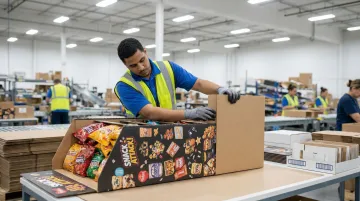
Fulfillment is the process of packing the finished display with the actual products it will sell. This phase is most cost-effective when it occurs in direct sequence with assembly—not as a separate, stored step. Double-handling significantly increases per-unit cost and introduces additional opportunities for error.
Staging and SKU Management
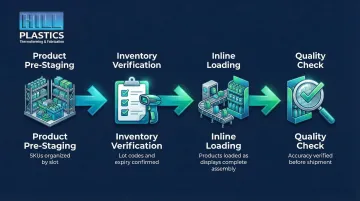
For projects involving multiple SKUs, careful pre-staging of products—organized by display slot, facing, or sequence—is essential to maintain flow and accuracy. Errors at this phase mean mispacked displays that need rework before they can ship.
A single kitting error sets off a chain reaction: a customer service call, a return, a reshipment, a packaging write-off, and lost operator time — five cost events from one mistake. Mispicks average $22 each, and across hundreds of displays, that exposure adds up fast.
Pre-staging prevents this by ensuring that products are organized, verified, and ready for immediate loading as displays come off the assembly line. This inline approach improves throughput by 20-50% compared to workflows that separate assembly and fulfillment.
Inventory Storage and Traceability
Products often arrive well in advance of display assembly. Brands must plan for bonded or managed storage, and for products with expiry dates or lot tracking requirements, inventory management systems that capture this data are critical to compliance and quality.
Failing to track lot codes or expiration dates can result in non-compliant displays reaching retailers — triggering chargebacks and straining those relationships. The solution is sequenced loading: the right product, with the right date and lot code, onto the right display, in the right order. Getting this wrong at scale is expensive; getting it right is a competitive advantage heading into Component 4.
Component 4: Distribution — Getting Displays to Retail on Time
Distribution strategy depends on two variables: where the display is going (brand's own distribution center vs. direct-to-retailer) and the timing pressure of the campaign launch. Both determine the shipping method and carrier selection.
DC Routing vs. Direct Shipment
The standard flow is for displays to ship back to the brand's distribution center, where they consolidate with larger store loads. This approach integrates POP displays into existing replenishment cycles and minimizes transportation costs.
For major rollouts or tight deadlines, drop-shipping directly to the retailer gets the display on the floor faster. This requires coordination with the retailer's preferred carriers and compliance with LTL vs. truckload requirements. For example, Walmart requires that all PO types be separated on the trailer, and loading staple stock and assembly POs on the same pallet is not allowed.
These carrier rules aren't suggestions — retailers enforce compliance through chargebacks. Kroger's fixed penalties illustrate the financial stakes:
- ASN errors: $200 per shipment
- Case labeling or pack errors: $500 per shipment
- UPC violations: $500–$5,000 per item per division
Errors at this stage translate directly into margin loss, so compliance documentation should be verified before freight leaves the facility.
Timing and Campaign Alignment
A display that arrives after the promotional window has closed delivers zero return on investment. Research shows a major snack brand achieved a 20% lift in new SKU velocity when field audits confirmed live setup in 90% of stores for four consecutive weeks. The 40% of displays set up incorrectly or not at all represent wasted budget, plain and simple.
Distribution timing must align with three calendars simultaneously:
- Promotional windows: the campaign dates your display was built around
- Retailer reset schedules: when store planograms change and floor space opens
- In-store merchandising appointments: when field teams are available to set the display
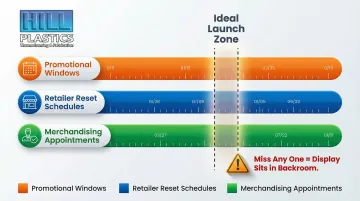
Miss any one of these, and the display sits in a backroom while the sales window closes.
Conclusion
The four components—design, assembly, fulfillment, and distribution—are not independent steps. They form a chain where a weak link in any one phase compromises the entire campaign's effectiveness. A beautifully designed display that fails retailer compliance never reaches the floor. A compliant design that's poorly assembled creates rework and delays. Proper assembly that's followed by mispacked products triggers costly returns. Flawless fulfillment undone by a late delivery means zero ROI.
Brands that plan each component deliberately—sourcing the right materials at the design stage and coordinating assembly, fulfillment, and distribution as a single unified program—don't just avoid failure. They build campaigns that actually move product on the floor.
Frequently Asked Questions
What does point of purchase display mean?
A POP display is a branded retail structure placed in high-traffic store locations—separate from standard shelving—designed to attract shopper attention and encourage unplanned purchases at or near the point where buying decisions are made.
What is an example of a point of purchase display?
Common examples include a freestanding floor display in a store aisle, a countertop display near the register, or an end-cap display at the end of a grocery aisle. Each format targets a different shopper behavior: impulse purchases, last-minute add-ons, or category browsing.
How much does a point of purchase display cost?
Costs vary widely based on display type, materials, and quantity. Temporary corrugated displays range from $5-$150 per unit, while permanent metal or thermoformed plastic structures can cost $150-$1,000+ per unit. Consult a manufacturer for an accurate quote based on your specific requirements.
What materials are used to make POP displays?
The most common materials include:
- Corrugated cardboard for short-term promotional displays
- Metal framing for structural support in semi-permanent builds
- Thermoformed or vacuum-formed plastic for durable, detail-rich components in permanent displays
What is the difference between a temporary and a permanent POP display?
Temporary displays (typically corrugated cardboard) are designed for short promotional windows of 4-12 weeks. Permanent displays use more durable materials such as metal, plastic, or composite, and are built to last 1-5+ years. They carry a higher upfront cost but deliver a longer ROI window.
How do you ensure a POP display meets retailer compliance requirements?
Retailer compliance requirements must be researched and incorporated during the design phase, covering dimensions, weight, height restrictions, and attachment methods. Working with an experienced display manufacturer familiar with major retailer guidelines reduces the risk of costly rejection.