What is custom thermoforming and how does the process work?
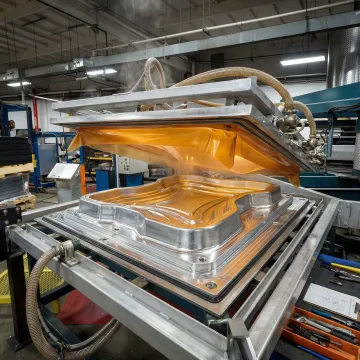
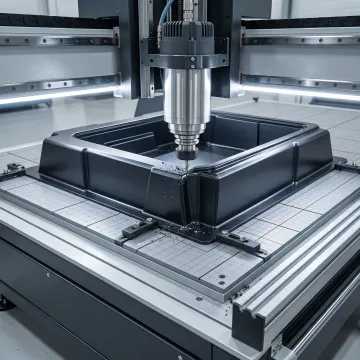
Custom thermoforming is a manufacturing process where plastic sheet material is heated to a specific forming temperature until pliable, then shaped over or into a mold using vacuum pressure to remove air between the material and mold surface. At Hill Plastics, we use eight thermoforming machines ranging from 2'x3' to 5'x9', including a high-speed 4'x7' rotary thermoformer. Once formed, parts are precision-trimmed to drawing specifications using CNC routers, punch presses, or saws, with secondary operations like drilling, heat bending, and assembly applied as needed for finished, assembly-ready components.
What materials can be used for thermoforming projects?
Hill Plastics works with a comprehensive range of thermoforming materials tailored to your application requirements. Common options include ABS (Acrylonitrile-Butadiene-Styrene) for impact resistance and durability, HDPE (High-Density Polyethylene) for chemical resistance, PETG (Polyethylene Terephthalate Glycol) for clarity and toughness, high-temperature ABS for elevated heat environments, UV-resistant ASA/ABS for outdoor exposure, decorative foil-laminated materials for aesthetic applications, polystyrene for cost-effective parts, and KYDEX for specialized industrial uses. Our engineering team helps you select the optimal material based on tensile strength, environmental conditions, chemical compatibility, cost, and regulatory compliance for your specific application.
How long does it take to produce thermoformed prototypes?
Hill Plastics can produce thermoformed prototypes in just a few weeks, depending on design complexity. We create low-cost master patterns from CNC-milled wood or polyurethane tooling to your specifications, which serve as molds for prototype production. This rapid prototyping approach allows you to evaluate fit, function, and appearance quickly without the investment required for production aluminum tooling. If design changes are needed after review, modifications can be easily made to the wood or polyurethane pattern, providing flexibility during the development phase before committing to final production tooling and high-volume manufacturing.
What are the advantages of thermoforming over other plastic manufacturing methods?
Thermoforming offers several key advantages: significantly lower tooling costs compared to injection molding, as master patterns are typically CNC-milled wood or polyurethane rather than expensive steel molds; faster lead times with tooling and prototypes often completed in weeks; cost-effective production of large parts that would be prohibitively expensive with other methods; design flexibility allowing quick modifications during prototyping; and scalability from short prototype runs to high-volume production. Additionally, thermoformed parts can achieve excellent surface finish, accommodate complex geometries, and be produced from a wide range of materials to meet specific performance requirements across aerospace, medical, telecommunications, and industrial applications.
What industries does Hill Plastics serve with thermoforming services?
Hill Plastics has 45 years of experience serving diverse industries including Aerospace & Aviation (aircraft interior components, enclosures), Telecommunications (radome enclosures, antenna housings), Medical Devices & Healthcare (equipment enclosures, device housings), Industrial Equipment and OEM Manufacturers (machine guards, custom enclosures), Defense & Military (specialized protective components), Point-of-Purchase and Retail Display (custom promotional displays), Marine (boat components, protective covers), Electronics & Electrical Equipment (housings, control panels), Oil & Gas/Energy (industrial enclosures), and Transportation & Logistics Equipment (material handling trays, protective components). Our expertise spans prototype development through high-volume production for each sector.
Can Hill Plastics handle both small prototype runs and large-scale production?
Yes, Hill Plastics has the capacity and expertise to support projects from initial prototyping through high-volume production. Our facility includes over 20,000 square feet of manufacturing space with eight thermoforming machines ranging from 2'x3' to 5'x9', including a 4'x7' rotary thermoformer with cycle times 2.5 times faster than standard equipment. For prototypes, we use low-cost wood or polyurethane tooling to produce small quantities for design validation. Once approved, we transition to durable aluminum production molds capable of producing thousands of parts with consistent quality. Our quality control system monitors production at every stage to ensure parts meet appearance standards and print specifications, whether you need 10 units or 10,000.
What secondary operations and finishing services are available?
Hill Plastics offers comprehensive secondary operations and finishing services to deliver assembly-ready parts. Our two 5'x10' CNC trimming centers provide precision trimming to exact drawing specifications, contour cutting, and edge finishing. Additional capabilities include CNC drilling for fastener holes and mounting points, heat bending for custom angles and complex shapes, bonding and welding for multi-part assemblies, riveting and mechanical fastening, threaded insert installation for assembly hardware, surface finishing and deburring, and custom fabrication work. We use SolidWorks CAD software integrated with our CNC equipment to ensure dimensional accuracy across all operations, supporting turnkey solutions from raw material to finished product.
How does Hill Plastics ensure quality control throughout the manufacturing process?
Hill Plastics employs a comprehensive custom quality control system that monitors production progress as it passes through all manufacturing stages. With 45 years of experience, our team—including staff with minimum tenures of 20 years as industry professionals—applies rigorous inspection protocols. Each part is evaluated for appearance quality, dimensional accuracy against print specifications, proper material selection and processing, correct execution of secondary operations, and overall conformance to customer requirements. Our quality approach begins with SolidWorks-driven design verification, continues through prototype evaluation and production tooling validation, and culminates in final inspection before shipment. This systematic quality assurance delivers the precision and consistency demanded by aerospace, medical, telecommunications, and industrial OEM customers.