Many innovators rush this stage or skip it entirely, making it one of the costliest mistakes in product development. According to NASA's Stecklein study, fixing a design error after launch can cost up to 1,500 times more than catching it during the requirements phase.
This guide explains what prototype manufacturing is, why it matters more than ever in 2026, the main types and methods available, how to navigate the process stages, and how to choose the right manufacturing partner. Whether you're an OEM manufacturer, startup founder, entrepreneur, or engineer in aerospace, medical, telecom, or industrial sectors, understanding prototype manufacturing will save significant time and money while reducing the risk of failed product launches.
Key Takeaways
- Prototype manufacturing creates preliminary models to test design, function, and manufacturability before mass production
- Multiple prototype types exist, from proof-of-concept models to pre-production units, each serving a distinct development stage
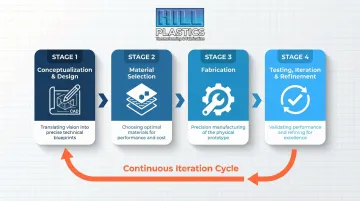
- The process moves through conceptualization, material selection, fabrication, and iterative testing
- Common methods include 3D printing, CNC machining, and vacuum forming/thermoforming — each with different cost, speed, and accuracy tradeoffs
- Choose manufacturers by evaluating experience, capabilities, lead times, and ability to scale toward full production
What Is Prototype Manufacturing and Why Does It Matter?
Prototype manufacturing is the process of creating one or more early-stage physical models of a product to evaluate design, functionality, fit, and manufacturability before committing to full-scale production. A prototype is a learning tool — built to surface problems while changes are still affordable, not after production tooling is locked in.
This practice is non-negotiable in modern product development. Design flaws caught at the prototype stage cost a fraction of what they cost once production tooling is locked in. Research shows that 90% of product launch delays stem from late-stage design changes, and a six-month delay can erode lifetime profitability by 33%. Earlier iteration means lower total development cost — every time.
Prototypes serve multiple purposes beyond internal testing:
- Securing investor funding with tangible proof of concept
- Gaining regulatory approvals through physical testing and validation
- Gathering early customer feedback before production commitment
- Validating market interest with a real, touchable product
Without adequate prototyping, companies face serious consequences—product recalls, delayed launches, wasted tooling investments, and misaligned user experiences that tank adoption rates.
The Expanding Role of Prototyping in 2026
Those risks have pushed the industry toward faster, cheaper iteration — and the tools to support that are evolving quickly. AI-assisted CAD design tools and advanced additive manufacturing are cutting the time and cost required to reach a functional prototype, opening the door for smaller manufacturers and entrepreneurs who previously couldn't afford multiple iteration cycles. AI-enabled digital threads can reduce development costs by up to 50% and accelerate time-to-market by 30%.
The 3D printing market for prototyping is projected to reach $13.47 billion in 2026 with a 15.44% compound annual growth rate, and 97% of manufacturing stakeholders now use 3D printing for functional prototypes or end-use parts.
Types of Prototypes Used in Product Development
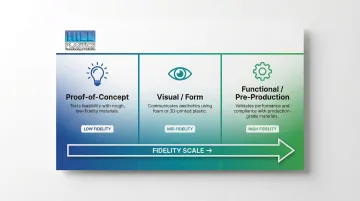
Not all prototypes serve the same purpose. The right prototype depends entirely on what you need to learn at that stage of development. Prototype fidelity—how closely a model resembles the final product—varies from low (rough concept models) to high (near-production samples).
The three main types each serve a distinct stage:
- Proof-of-Concept (PoC) — tests technical feasibility before investing in form or function
- Visual/Form — communicates shape, proportion, and aesthetics to stakeholders
- Functional/Pre-Production — validates performance, manufacturability, and regulatory compliance
Proof-of-Concept (PoC) Prototypes
PoC prototypes are the earliest form, built primarily to test whether a core concept or mechanism is technically feasible. These rough, low-fidelity models typically don't resemble the final product and aren't meant for user testing or investor presentations.
The key distinction: a PoC tests whether something can work, while a Minimum Viable Product (MVP) tests whether a working product meets a real user need in the market. PoC prototypes often use simple or temporary components just to prove the mechanism functions.
Visual and Form Prototypes
Visual prototypes focus on shape, proportion, and aesthetics rather than function. They communicate the look and feel of a product to stakeholders, investors, or focus groups. Materials like foam, cardboard, or 3D-printed plastic are common at this stage because exact material properties don't matter yet—only the visual design.
Functional and Pre-Production Prototypes
Functional prototypes incorporate working mechanisms and are built to test performance, durability, and user experience under real or simulated conditions. These prototypes use materials that closely match production-grade properties.
Pre-production (pilot) prototypes represent the final evolution: near-exact representations of the production-ready product. They validate manufacturing processes, finalize bills of materials, and confirm regulatory compliance before tooling is committed—making them the last checkpoint before full-scale production begins.
The Prototype Manufacturing Process: Key Stages
Prototype manufacturing is an iterative cycle, not a linear checklist. Teams should expect to move through multiple generations of prototypes, with each cycle becoming progressively less disruptive as the design matures. Hardware products typically require 5 to 12 prototype iterations before production, depending on complexity and regulatory requirements.
Stage 1: Conceptualization and Design
Every prototype starts with translating an idea into defined specifications: dimensions, materials, key features, and performance requirements. CAD software then enables virtual modeling and design validation — catching obvious errors before any physical material is committed.
Even so, CAD models don't always surface real-world challenges: component fit, assembly complexity, or material behavior under stress. Physical prototyping remains necessary even with the most advanced digital tools.
Stage 2: Material Selection
Material choice is driven by the prototype's purpose. Concept models can use foam, wood, or basic plastics, while functional and pre-production prototypes need materials that closely match production-grade properties—strength, heat resistance, chemical resistance, and durability.
For plastic parts specifically, thermoformable sheet materials are commonly used in functional prototyping:
- ABS (Acrylonitrile-Butadiene-Styrene) for versatile engineering applications
- PETG (Polyethylene Terephthalate Glycol) offering clarity and durability
- Polycarbonate for high-impact applications
- HDPE (High-Density Polyethylene) for cost-effective solutions
Material selection dictates process selection—the material you need may determine which manufacturing method is feasible.
Stage 3: Fabrication
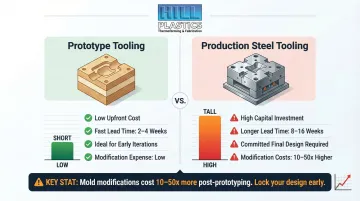
The fabrication stage is where the prototype is physically built using the chosen manufacturing method. For plastic prototype parts, low-cost tooling—such as wood or polyurethane molds—dramatically reduces upfront tooling investment compared to production steel tooling.
This is the stage where design intent meets physical reality. Discrepancies in dimensions, fits, and surface finishes are first discovered here, providing concrete feedback for the next iteration.
Stage 4: Testing, Iteration, and Refinement
Testing is where a prototype earns its keep. Testing types include:
- Functional testing: Confirms the part performs its intended function under real operating conditions
- Durability testing: Evaluates performance under stress, wear, temperature extremes, and environmental exposure
- User experience testing: Assesses ergonomics, ease of assembly, and real-world usability
Findings from testing should directly feed back into the next design iteration. This cycle continues until the prototype meets all specifications and is validated as production-ready. Early validation reduces mass-production defects by 30–60%.
Common Prototype Manufacturing Methods
Choosing the right method depends on five factors:
- Material requirements — production-grade metal, engineering plastic, or prototype-grade material
- Dimensional accuracy — the tolerance window your design demands
- Production volume — one-off proof-of-concept vs. small functional batch
- Lead time — days vs. weeks available before the next design gate
- Budget — tooling investment vs. per-part cost tradeoff
Many products move through multiple methods across prototype generations as requirements tighten.
3D Printing and Additive Manufacturing
3D printing—including FDM, SLA, and SLS processes—is the go-to for fast, low-cost early prototypes with complex geometries. Accuracy ranges from ±0.008" for FDM to ±0.15% for SLA, with production typically completed in hours to days.
Key limitations include:
- Surface finish quality typically requires post-processing
- Material options are narrower than production-grade processes
- Printed parts are often less strong than machined or molded equivalents due to layer bonding characteristics
CNC Machining
CNC machining is a subtractive process that delivers high dimensional accuracy—standard tolerances of ±0.005" and precision tolerances of ±0.002"—and can use production-grade materials including metals and engineering plastics.
This makes it ideal for functional prototypes that need tight tolerances. CNC typically costs more and takes longer than 3D printing but produces parts much closer to final production quality.
Vacuum Forming and Thermoforming
For plastic parts, vacuum forming and thermoforming stand out as some of the most efficient prototyping options — particularly for enclosures, housings, trays, covers, and large-format panels.
The process: a plastic sheet is heated and shaped over a mold. At the prototype stage, the mold can be low-cost wood or polyurethane tooling rather than expensive production steel. Production time for vacuum forming tooling is typically half as long as injection molding tooling.
Key advantages:
- Very low tooling costs for prototypes compared to injection molding
- Fast turnaround from design to physical part
- Cost-effective path for plastic enclosures and custom parts
- Ideal for large panels and aerospace interior components
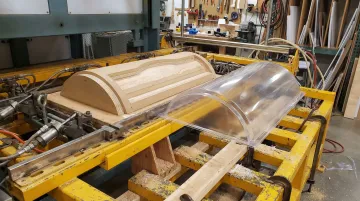
Hill Plastics, a Lewisville, TX thermoformer with over 45 years in the field, uses this exact approach for OEM and entrepreneur clients. Their team works from customer drawings in SolidWorks, builds wood or polyurethane prototype tooling, and delivers formed parts in a few weeks — giving engineers a physical part to validate before investing in production-grade tooling.
Injection Molding
Injection molding produces the highest-fidelity plastic prototypes with production-equivalent accuracy and surface finish. Tolerances range from ±0.005" to ±0.010"+, matching production standards.
However, tooling costs are significantly higher and lead times are longer. This method is reserved for late-stage functional or pre-production prototypes where high volumes or exact production-grade material properties are required.
How to Choose the Right Prototype Manufacturer
Choosing a prototype manufacturing partner is about more than finding someone who can build the part. The right partner understands your end goal (mass production), anticipates downstream manufacturability challenges, and can scale with you through the product development lifecycle.
Key evaluation criteria:
- Proven experience with your product category and materials
- In-house capabilities that match your prototype method — no outsourced surprises
- Quality systems and documentation that meet your compliance requirements
- A dedicated contact who stays with the project from first design review to final part
- Lead time commitments grounded in actual shop capacity, not best-case estimates
Once you've evaluated the basics, dig into tooling strategy — especially for plastic parts. Low-cost prototype tooling in wood or polyurethane is a major cost differentiator versus jumping straight to production steel tools. Hill Plastics, for example, uses wood and polyurethane tooling for thermoforming prototypes, which keeps early-stage costs manageable before committing to full production tooling.
Intellectual Property Protection
When sharing CAD files and design specifications with a manufacturer, ask about NDAs, data security practices, and access control protocols. The USPTO advises filing a provisional patent application before making significant disclosures to establish a priority date and protect against independent development.
Domestic manufacturers in the U.S. offer stronger IP enforcement options compared to overseas alternatives, particularly important given that most countries require absolute novelty before public disclosure.
Design for Manufacturability Matters
Choose a partner who integrates Design for Manufacturability (DFM) principles early in the prototype phase. Applying DFM principles early cuts product development time and material costs by 15% to 30%. Conversely, 33% of product delays are caused by DFM defects discovered during mass production.
The earlier DFM feedback enters the process, the less it costs to act on it — catching a wall thickness problem during prototyping is a design revision; catching it after tooling is a budget crisis.
How Much Does Prototype Manufacturing Cost?
There is no standard price for prototype manufacturing. A simple concept model produced via 3D printing may cost a few hundred dollars; a functional pre-production prototype in production-grade materials can run into tens of thousands.
Cost is shaped by several factors: part complexity, manufacturing method, materials, quantity needed, and the level of engineering support involved.
What Drives the Cost
- Engineering and design hours
- Cost of raw materials or components
- Fabrication/machining labor
- Assembly work
- Testing procedures
- Tooling cost (major variable)
Of these, tooling tends to swing cost the most. Low-cost prototype tooling in wood or polyurethane — common in thermoforming — runs far less than hard steel tooling, which is typically reserved for production runs. Getting design revisions done at the prototype stage matters: mold modifications cost 10–50 times more once you're past prototyping.
How to Keep Prototype Costs Under Control
- Prioritize the features that matter most for each prototype generation—don't pay for production-grade finish on a proof-of-concept
- Get quotes from multiple manufacturers to understand market rates
- Ask about substituting lower-cost materials or processes that still meet testing requirements
- Be explicit with manufacturers about your budget ceiling upfront
- Consider phasing prototype development to spread costs across multiple budget cycles
Frequently Asked Questions
What is prototype manufacturing?
Prototype manufacturing is the process of creating early-stage physical models of a product to test design, function, and manufacturability before committing to full-scale production. It serves as a critical validation step that exposes problems while changes remain affordable.
What are the stages of prototype development?
The core stages are conceptualization and CAD design, material selection, fabrication, and iterative testing and refinement. Teams typically cycle through multiple prototype generations before reaching a production-ready version.
What are the main types of prototypes used in product development?
The main types are proof-of-concept, visual/form, functional, and pre-production prototypes. Each serves a different development stage, with fidelity to the final product increasing at each step.
What's the difference between an MVP and a PoC?
A Proof of Concept (PoC) tests whether a core technology or mechanism is technically feasible, often using improvised materials. A Minimum Viable Product (MVP) is a functional product with enough features to test market viability and gather real user feedback using stable, production-intent components.
How much does prototype manufacturing cost?
Costs vary based on complexity, materials, and manufacturing method. Basic 3D-printed concept models may run a few hundred dollars, while high-fidelity functional prototypes can reach tens of thousands. Tooling choice is a major factor — wood or polyurethane molds cost far less than production steel.
What are examples of product prototypes?
Common examples include thermoformed enclosures for telecom radomes, CNC-machined medical device housings, 3D-printed consumer product concepts, and vacuum-formed aircraft interior components. Each reflects a different method and fidelity level suited to its industry and development stage.