

Introduction
Picture a commercial aircraft slicing through a thunderstorm at 35,000 feet. The pointed nose cone isn't just an aerodynamic flourish—it's hiding one of aviation's most critical safety systems. That distinctive cone is a radome, a protective enclosure that shields the aircraft's weather radar while remaining completely transparent to the electromagnetic signals that detect dangerous storm cells ahead.
A radome faces a brutal engineering paradox: it must be physically tough enough to survive bird strikes, hailstones traveling at 500 mph, and temperature swings from -60°F to +150°F, yet electromagnetically invisible, allowing radar signals to pass through as if it weren't there at all. Any signal degradation can mean the difference between routing around a severe weather cell and flying directly into it.
This article unpacks what radomes are, why they're mission-critical in aeronautics, the materials that make them work, the different types found on aircraft, and their applications beyond aviation—from telecommunications towers to maritime satellite systems.
Key Takeaways
- A radome (radar + dome) protects radar and antenna systems from extreme weather while allowing electromagnetic signals to pass through without distortion
- Aircraft radomes serve dual roles: shielding delicate electronics and reducing aerodynamic drag as streamlined fairings
- Radome design balances two competing requirements: mechanical toughness for structural protection and RF transparency for clean signal transmission
- Common materials include fiberglass composites, sandwich structures with honeycomb cores, and PTFE-coated fabrics, each chosen for electromagnetic and structural properties
- Beyond aircraft, radomes appear in ground radar stations, cellular towers, and maritime satellite communication systems
What Is a Radome? Definition, Etymology, and Origins
The term "radome" is a portmanteau blending "radar" and "dome," coined around 1944 to describe a weatherproof enclosure that protects radar antennas while being transparent to radio waves. Despite the "dome" in the name, radomes take many shapes — spherical, geodesic, planar, conical, and cylindrical — depending on the antenna configuration and application.
You've likely seen radomes without realizing it. They show up in more places than most people expect:
- Pointed nose cones on commercial airliners house weather radar
- Large white spherical domes near airports protect ground-based surveillance radar dishes
- Cylindrical shrouds on telecommunications towers shield directional antennas from wind and ice
The WWII Birth of Airborne Radomes
The first documented in-flight radome flew in March 1941, when the MIT Radiation Laboratory equipped a B-18A bomber with a specialized Plexiglas nose to protect experimental microwave interception radar. This successful test detected surfaced submarines at three miles, proving that airborne radar enclosures were viable.
The urgent military need for radomes during World War II directly drove the development of fiberglass as a structural material. Early wartime radomes used plywood, but plywood absorbs moisture and resists bending into the doubly curved shapes required for aerodynamic fairings. To solve this, MIT developed the three-layer "A-sandwich" in 1944: dense fiberglass skins surrounding a low-density polystyrene core. That construction became the template for modern composite radome design.
Why Radomes Are So Critical in Aeronautics
Protecting Critical Electronics from Brutal Environments
Aircraft fly through environments that would destroy exposed electronics within minutes. Rain at cruising speed hits with kinetic energy comparable to sandblasting. Hailstones become projectiles. Ice accumulation adds weight and blocks signals. Bird strikes deliver severe impact forces.
Without the radome, the delicate antenna assemblies, waveguides, and mounting hardware behind the nose cone would be rapidly destroyed, making weather detection, terrain-following radar, and air traffic control communication impossible.
The Aerodynamic Fairing Function
On fixed-wing aircraft, the radome serves as an aerodynamic fairing that streamlines the antenna system to reduce drag. A poorly designed radome that creates unnecessary turbulence or pressure drag measurably affects fuel efficiency and aircraft performance.
That creates a tough engineering trade-off: the optimal aerodynamic shape (a smooth, elongated cone) may not be the optimal RF shape, which prefers uniform wall thickness and minimal curvature.
Electromagnetic Transparency: The "Invisible" Requirement
The radome must be electromagnetically transparent—effectively invisible to the radar frequencies it protects. Any distortion, reflection, or absorption of radio waves (called RF attenuation or signal degradation) corrupts target detection data, reduces range accuracy, or causes air traffic control to receive unreliable echo returns.
Surface contamination is particularly dangerous. A continuous water film or ice layer causes severe transmission losses, especially at higher frequencies:
- C-Band (4.2 GHz): ~0.5 dB loss in moderate rain
- X-Band (~10 GHz): 12-14 dB loss in heavy artificial rain (two-way)
- Ku/Ka-Band (20 GHz): Up to 14.2 dB loss with standard radomes in moderate rain
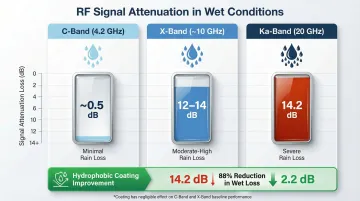
These multi-dB losses can effectively blind high-frequency communication and weather radar systems. Hydrophobic coatings address this problem by forcing water to bead into droplets rather than forming a continuous sheet, reducing the same 20 GHz loss from 14.2 dB to just 2.2 dB.
Safety Implications: When Radomes Fail
Those transmission losses have real consequences in the cockpit. Weather radar is the primary tool pilots use to detect and avoid dangerous storms, and even minor signal degradation can compromise the ability to route around severe weather cells.
A French BEA investigation into an Airbus A350 incident revealed how critical radome integrity is. A prior bird strike caused the radome's inner skin to debond internally—invisible from the exterior. The trapped air expanded at altitude, creating a bubble that blocked the weather radar antenna and triggered fault alerts.
The radome eventually collapsed in flight, disrupting aerodynamic flow and severely impairing the aircraft's air data probes.
The FAA classifies radomes as critical airframe components. Even slight physical changes—excessive paint layers or moisture ingress—adversely affect radar performance by altering electrical thickness, causing signal loss, target distortion, and display clutter.
Personnel Safety and Operational Security
Radomes on ground installations serve an additional purpose: protecting nearby personnel from being struck by rapidly rotating radar antennas. In defense applications, the enclosure conceals the direction and configuration of sensitive antenna arrays, preventing adversaries from determining radar coverage patterns.
Types of Radomes Found on Aircraft
Nose Cone Radomes
The most recognizable aircraft radome is the nose cone on fixed-wing commercial and military aircraft, housing forward-looking weather radar. These radomes feature conical or ogival (pointed oval) shapes designed to minimize drag while maintaining radar beam performance.
Commercial aircraft nose radomes must survive high-speed impacts with rain droplets (causing erosion), birds, and hail. The FAA notes that static discharges frequently burn holes through radome structures, allowing moisture to enter and delaminate the honeycomb core.
Military aircraft nose radomes house fire control radar, terrain-following radar, or targeting systems. Shape requirements differ from commercial weather radomes because military missions demand specific radar beam angles, wider scanning coverage, and stealth profiles that reduce radar cross-section—requirements the F-22's sculpted nose radome illustrates well.
Rotodomes
The Boeing E-3 Sentry Airborne Warning and Control System (AWACS) features the most distinctive radome in military aviation: the rotodome. This disc-shaped radome mounts 30 feet in diameter and 6 feet thick, positioned 11 feet above the fuselage on two struts.
The rotodome rotates hydraulically at 6 RPM to provide 360-degree scanning coverage for its pulse-Doppler surveillance radar. The rotation and large flat disc shape create unique structural challenges—the radome must withstand centrifugal forces, gyroscopic effects, and aerodynamic loads while maintaining RF transparency across the entire rotating assembly.
Fuselage Blister Radomes
Blister radomes are the bulged dome-shaped housings mounted on aircraft fuselages to cover satellite communication antennas used for beyond-line-of-sight communication. Most commercial passenger aircraft now carry at least one for in-flight connectivity (IFC) systems delivering passenger Wi-Fi and live television.
Modern designs like the Boeing Tri-band radome pack considerable capability into a low-profile housing. Key specifications include:
- Supports Ku, K, and Ka frequencies simultaneously
- Adds just 0.05%–0.17% incremental fuel burn
- ARINC 791/792 compliant for standardized aircraft integration
- Houses electronically steered phased-array antennas that track satellites through aircraft maneuvers
What Materials Are Used to Build Radomes—and Why It Matters
The Fundamental Design Challenge
Radome materials face competing requirements: they must provide structural strength to withstand aerodynamic loads, impact forces, and temperature extremes while maintaining electromagnetic transparency across specific frequency bands (C-band, X-band, Ku-band, Ka-band). These requirements pull in opposite directions—thicker, stronger materials tend to attenuate RF signals more.
Fiberglass: The Dominant Material
Glass-fiber reinforced plastic (GFRP) remains the predominant material for aircraft radome shells because it delivers:
- Excellent transparency to electromagnetic waves across most radar frequency bands
- Good strength-to-weight ratio for structural loads
- Reasonable cost compared to exotic composites
- Resistance to weather, UV exposure, and chemical degradation
Application methods vary—woven fabrics, prepregs, and hand-laid laminates—based on performance requirements and production scale.
Sandwich Composite Structures
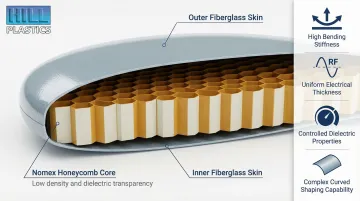
Many high-performance radomes use sandwich construction—thin fiberglass or aramid fabric skins surrounding a low-density core material such as Nomex honeycomb or rigid foam. This architecture achieves the rigidity needed for structural loads and precise aerodynamic shaping while keeping weight minimal.
The structural benefits extend directly to RF performance:
- Provides bending stiffness without adding mass
- Maintains uniform electrical thickness for consistent RF performance
- Allows precise control of dielectric properties through core selection
- Enables complex doubly curved shapes required for aerodynamic fairings
Weight reduction is critical in aerospace applications—every pound of radome weight reduces payload capacity or requires additional fuel. Sandwich composites deliver the best stiffness-to-weight performance available.
Thermoforming for Cost-Effective Production
For certain radome configurations—particularly telecommunications tower enclosures and ground-based antenna covers—thermoformed plastic panels offer an efficient, cost-effective manufacturing path. Thermoforming heats plastic sheets to forming temperature, then shapes them over precision molds using vacuum or pressure.
Surface performance matters just as much as structural material. Hydrophobic and ESD-protective coatings are applied to radome exteriors to prevent water accumulation—which degrades RF performance—and to dissipate static electricity buildup. Measured results indicate that applying hydrophobic paint to a degraded radome can reduce wet transmission loss from 3 dB down to 0.25 dB at 20 GHz, a significant recovery in signal throughput.
Radomes Beyond the Aircraft: Telecom, Maritime, and Ground Systems
Ground Radar Radomes
The large spherical or geodesic domes near airports and on military installations protect rotating radar antenna dishes from ice, wind, and debris. These structures are often massive—the United States NEXRAD WSR-88D weather radar network uses rigid fiberglass sandwich radomes measuring 39 feet in diameter.
Ice accumulation is especially dangerous on ground radomes because it de-tunes the antenna, causing the Voltage Standing Wave Ratio (VSWR) to rise drastically. This reflects power back into the transmitter, risking severe overheating and hardware failure. Large ground radomes often incorporate internal electric heaters to melt accumulating ice.
Telecommunications Tower Radomes
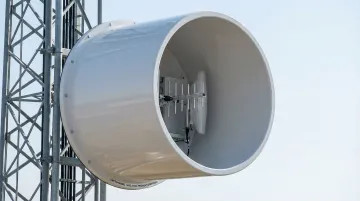
Radomes are widely used on cellular and microwave relay towers to protect directional antennas from wind loading, ice accumulation, and physical damage. These cylindrical or planar shrouds serve several functions:
- Reduce wind resistance on tower-mounted antennas
- Prevent ice buildup that alters antenna tuning
- Conceal equipment from vandalism
Hill Plastics has manufactured custom radomes for the telecommunications industry since 1977, with clients including CommScope and Antenna Products. Their thermoforming process produces electromagnetically transparent enclosures to tight dimensional tolerances, in quantities from prototypes to thousands of units.
Maritime Radomes
Ships and yachts use dome-shaped radomes to protect stabilized satellite dish antennas that continuously track fixed satellites even as the vessel pitches and rolls. Size varies considerably by vessel class. Small private yachts use radomes as compact as 26 cm in diameter, while large cruise ships and oil tankers deploy radomes exceeding 3 meters to house high-capacity broadband VSAT (Very Small Aperture Terminal) systems.
Maritime radomes must resist corrosive salt spray, extreme UV exposure, and mechanical shock from wave impacts while maintaining RF transparency across Ku-band and Ka-band satellite frequencies.
Frequently Asked Questions
What is a radome on an aircraft?
An aircraft radome is a weatherproof structural enclosure—most commonly the pointed nose cone—that houses and protects the aircraft's radar and antenna systems while allowing radar signals to pass through without distortion. It also serves as an aerodynamic fairing to reduce drag and streamline airflow around the antenna assembly.
What is the difference between radar and radome?
Radar is the electronic system that emits and receives radio waves to detect objects, weather, or terrain. The radome is the physical protective enclosure that surrounds and shields the radar's antenna from environmental damage. The radome itself is not a sensing system—it is purely structural and protective.
What is the difference between antenna and radome?
The antenna is the active component that transmits and receives electromagnetic signals, converting electrical energy into radio waves and vice versa. The radome is the passive protective housing built around the antenna, designed to be structurally strong yet electromagnetically transparent so it does not interfere with the antenna's signal transmission or reception.
What are the different types of antenna radomes?
The main radome types are:
- Nose cone radomes — commercial weather radar and military fire control systems
- Rotodomes — AEW&C aircraft for 360-degree surveillance (e.g., the E-3 Sentry)
- Fuselage blister radomes — satellite communications on commercial aircraft
- Spherical/geodesic radomes — airport and defense radar ground installations
- Telecommunications tower radomes — cylindrical shrouds protecting directional antennas
What is radome used for?
Radomes serve three primary purposes:
- Physical protection — shields radar and antenna hardware from weather, debris, and bird strikes
- Signal integrity — blocks environmental interference such as rain, ice, and moisture from affecting electronics
- Aerodynamic shaping — in aviation, the streamlined form reduces drag and improves fuel efficiency
Can radomes be repaired?
Yes. Surface cracks, erosion, and coating degradation can typically be patched or re-coated by certified repair facilities. Structural damage, internal delamination, or significant RF performance loss may require full replacement. FAA and RTCA DO-213A standards mandate Transmission Efficiency testing after any repair to confirm signal integrity is restored.