What types of equipment enclosures can Hill Plastics manufacture?
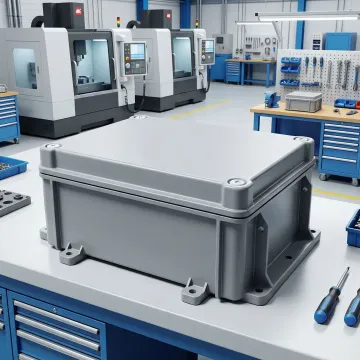
Hill Plastics manufactures a comprehensive range of custom equipment enclosures including industrial machine guards, telecom radome housings, aerospace component covers, medical device enclosures, electronic equipment housings, and OEM protective casings. Our thermoforming and fabrication capabilities accommodate enclosure sizes from 2'x3' up to 5'x9', with options for precision CNC trimming, drilling, heat bending, and assembly operations. We work with diverse materials including ABS, PETG, HDPE, high-temperature ABS, UV-resistant ASA/ABS, and KYDEX to meet specific environmental, impact, and durability requirements across aerospace, telecommunications, medical, industrial, marine, and other demanding applications.
How long does it take to produce a custom enclosure prototype?
Hill Plastics can typically produce custom enclosure prototypes in just a few weeks, depending on design complexity. We use cost-effective wood or polyurethane tooling for rapid prototype development, allowing you to evaluate fit, function, and design before committing to production aluminum molds. Our master patterns are CNC-milled to your exact print specifications, and changes can be easily incorporated during the prototype phase. This accelerated prototyping process enables quick design iteration and validation, helping you bring your enclosure solution to market faster while maintaining precision and quality standards throughout the development cycle.
What materials are best for outdoor equipment enclosures?
For outdoor equipment enclosures, Hill Plastics recommends UV-resistant ASA/ABS formulations that withstand prolonged sun exposure without degrading, high-temperature ABS for applications experiencing heat buildup, and PETG for excellent weather resistance and impact strength. Material selection depends on your specific environmental requirements including UV exposure, temperature extremes, chemical contact, and impact resistance needs. Our engineering team evaluates factors like cost, tensile strength, chemical resistance, and durability to recommend the optimal material for your application. We also offer decorative foil laminated materials for outdoor enclosures requiring aesthetic appeal alongside environmental protection, ensuring long-term performance across demanding outdoor installations.
Can you handle both small prototype runs and large-scale production?
Yes, Hill Plastics has the facility space, equipment, and expertise to handle everything from single prototypes to high-volume production runs of thousands of enclosures. Our eight thermoforming machines ranging from 2'x3' to 5'x9', including a 4'x7' rotary thermoforming system with 2.5x faster cycle times, enable scalable production to match your volume requirements. We use low-cost wood or polyurethane tooling for prototypes and short runs, then transition to aluminum production molds for high-volume manufacturing. This flexibility ensures cost-effective solutions whether you need five prototypes for design validation or 10,000 production enclosures with consistent quality control, competitive pricing, and quick turnaround times.
What secondary operations are available for custom enclosures?
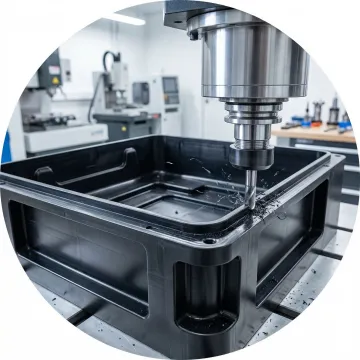
Hill Plastics offers comprehensive secondary operations to deliver assembly-ready custom enclosures. Our capabilities include precision CNC trimming to exact drawing specifications using two 5'x10' trimming centers, precision drilling for mounting holes and fastener preparation, heat bending for custom contours and edge forming, bonding and welding for multi-piece enclosure assembly, riveting and fastener installation, threaded insert installation for secure mounting points, and professional edge finishing for clean, smooth surfaces. These secondary operations eliminate the need for downstream fabrication, delivering finished enclosures ready for installation. Our SolidWorks-driven CNC interface ensures dimensional accuracy and repeatability across all fabrication operations.
How does thermoforming compare to other enclosure manufacturing methods?
Thermoforming offers several distinct advantages for custom equipment enclosures compared to injection molding or metal fabrication. The primary benefits include significantly lower tooling costs—wood or polyurethane patterns cost a fraction of injection mold tooling, making thermoforming ideal for low to medium production volumes. Lead times are dramatically shorter, with tooling and prototypes often ready in weeks rather than months. Large enclosures can be manufactured cost-effectively relative to their size, as thermoforming scales well for bigger parts. Design changes are easily accommodated in prototype tooling before committing to production molds. Additionally, thermoformed enclosures offer excellent strength-to-weight ratios, corrosion resistance, and design flexibility for complex geometries, making them ideal for aerospace, telecommunications, industrial, and medical applications requiring custom protective housings.
What industries does Hill Plastics serve with custom enclosures?
Hill Plastics serves a diverse range of industries requiring precision custom equipment enclosures, including aerospace and aviation for lightweight protective housings and radomes, telecommunications for antenna radome enclosures and signal equipment protection, medical devices and healthcare for sterilizable equipment covers and device housings, industrial equipment and OEM manufacturers for machine guards and component enclosures, defense and military for ruggedized protective casings, electronics and electrical equipment for control panel housings and protective covers, oil and gas energy sector for harsh environment enclosures, marine applications for corrosion-resistant housings, transportation and logistics equipment, and point-of-purchase retail displays. Our 45 years of experience and versatile manufacturing capabilities support custom enclosure requirements across these demanding industries.
What quality control measures ensure enclosure precision and consistency?
Hill Plastics employs a comprehensive custom quality control system that monitors enclosure production progress through all manufacturing stages. Parts are quality controlled for both appearance and adherence to print specifications, with dimensional verification performed using precision measurement tools. Our CNC trimming operations ensure repeatable accuracy to drawing specifications across production runs. Staff members with minimum 20-year industry tenure bring deep expertise to quality oversight. We validate prototype enclosures for fit and function before approving production tooling, and production parts undergo rigorous inspection for dimensional accuracy, material integrity, surface finish quality, and proper execution of secondary operations like drilling, bending, and assembly. This multi-stage quality approach, backed by 45 years of manufacturing experience, ensures consistent, high-quality enclosures that meet exacting aerospace, medical, telecommunications, and industrial standards.