What materials are best for rackmount server enclosures?
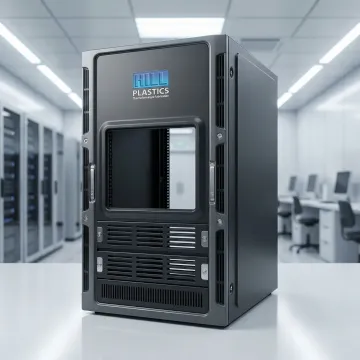
Material selection depends on your specific thermal, impact, and environmental requirements. High-temperature ABS offers excellent heat resistance for equipment with significant thermal output, while UV-resistant ASA provides superior outdoor durability for telecommunications installations. PETG delivers exceptional impact resistance and clarity for applications requiring visual inspection. Our engineering team evaluates operating temperatures, required impact protection, chemical exposure, EMI shielding needs, and budget constraints to recommend the optimal material. We can also incorporate decorative foil-laminated materials for aesthetic requirements or specify materials meeting specific fire-rating standards for data center compliance.
How long does it take to develop a custom enclosure prototype?
Using our low-cost wooden or polyurethane tooling approach, we typically deliver functional prototypes within 3-4 weeks from approved design specifications. The timeline begins with our engineering team reviewing your CAD files or drawings, then CNC-machining a master pattern to exact specifications. Once mounted on a mold base, we thermoform initial samples for your evaluation. This rapid prototyping process allows you to test fit, function, and thermal performance before committing to production aluminum tooling. If design modifications are needed, adjustments to wooden patterns are straightforward and cost-effective, ensuring your final enclosure meets all requirements before volume production begins.
Can you accommodate specific rack mounting standards?
Absolutely. Our CNC fabrication capabilities ensure precise compliance with EIA-310 standard rack dimensions and mounting hole patterns. We routinely manufacture enclosures compatible with 19-inch rack systems, 23-inch telecommunications racks, and custom mounting configurations. Our two 5'x10' CNC trimming centers deliver exact hole spacing for mounting rails, precise U-height dimensions, and accurate depth specifications. We can integrate threaded inserts for secure fastener attachment, incorporate cable management features, and add ventilation patterns while maintaining structural integrity. Whether you need 1U, 2U, 4U, or custom-height enclosures, our engineering team ensures dimensional accuracy and proper clearances for seamless rack integration.
What production volumes can you support?
Hill Plastics scales from single prototypes to high-volume production runs of thousands of units. Our facility houses eight thermoforming machines ranging from 2'x3' to 5'x9', plus a 4'x7' rotary thermoforming machine that delivers cycle times 2.5 times faster than standard equipment for cost-effective mass production. Over 20,000 square feet of manufacturing space accommodates simultaneous projects at various production stages. For short runs, we use cost-effective tooling and single-station thermoforming. For volumes exceeding several hundred units, our rotary equipment significantly reduces per-unit costs while maintaining strict quality control. Every production run undergoes inspection for dimensional accuracy and appearance to ensure consistent quality regardless of volume.
Do you offer design assistance for enclosure optimization?
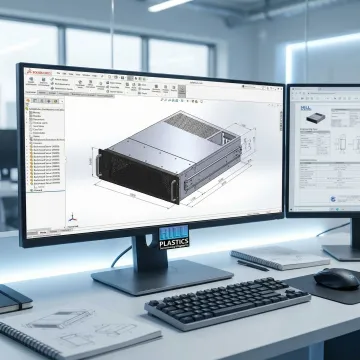
Yes, our sales and engineering team provides comprehensive design support throughout the development process. Brad and Cody Hill work with clients to optimize enclosure designs for thermoforming manufacturability, recommending draft angles, corner radii, and wall thickness that ensure consistent forming and structural performance. We use SolidWorks for CAD design and CNC interface, allowing seamless collaboration with your engineering team. Our expertise includes ventilation design for thermal management, material specification for specific operating environments, tooling recommendations to balance cost and production efficiency, and assembly methods that simplify installation. This consultative approach transforms initial concepts into manufacturable, cost-effective solutions that meet all functional requirements.
What secondary operations can you perform on enclosures?
Our fabrication department offers comprehensive secondary operations to deliver assembly-ready enclosures. Services include precision CNC drilling for mounting points and ventilation patterns, heat bending for complex geometries and flanges, bonding and welding for multi-piece assemblies, riveting for structural reinforcement, threaded insert installation for secure fastener attachment, edge finishing for smooth, safe handling surfaces, and hardware installation including mounting rails and cable management components. We can also apply EMI shielding, integrate gasket channels for environmental sealing, and perform custom finishing operations. This turnkey capability means your enclosures arrive ready for equipment integration, reducing your assembly time and labor costs.
How do you ensure consistent quality across production runs?
Hill Plastics employs a custom quality control system that monitors production at every stage. After 45 years in business, we've developed rigorous inspection protocols that verify dimensional accuracy against drawing specifications, surface finish quality, material consistency, and proper execution of all secondary operations. Parts are inspected as they progress through thermoforming, CNC trimming, and fabrication stages. Our experienced staff—many with 20+ years tenure—understand the critical tolerances required for rackmount applications and perform in-process checks using precision measuring equipment. Final inspection confirms all mounting holes align properly, ventilation patterns meet specifications, and assemblies integrate correctly. This multi-stage approach ensures every enclosure meets your exact requirements, whether producing ten units or ten thousand.
What are the cost advantages of thermoforming versus other methods?
Thermoforming offers significant economic advantages for custom enclosures compared to injection molding or metal fabrication. Tooling costs are substantially lower—wooden prototyping molds cost a fraction of injection mold tooling, and even production aluminum molds represent 60-80% savings versus comparable injection tooling. This makes low-to-medium volume production extremely cost-effective. Large enclosures that would be prohibitively expensive in injection molding become economically feasible through thermoforming. Lead times are shorter—we can produce tooling and prototypes in weeks rather than months. Material costs are competitive, especially for larger parts. Setup changes are faster, supporting product variations without expensive tooling modifications. For rackmount enclosures requiring custom dimensions, specialized ventilation, or moderate production volumes, thermoforming delivers superior value while maintaining excellent quality and precision.