What is HDPE thermoforming and how does it work?
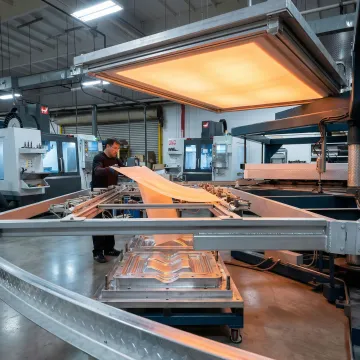
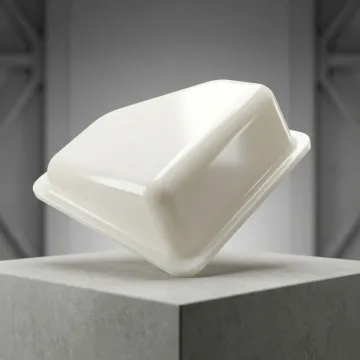
HDPE thermoforming is a manufacturing process where high-density polyethylene plastic sheets are heated to a precise forming temperature (typically 280-320°F for HDPE), then shaped over a custom mold using vacuum pressure or mechanical force. At Hill Plastics, we remove air between the heated sheet and the mold surface, allowing atmospheric pressure to form the plastic into the desired shape. The formed part is then cooled, trimmed to exact specifications using CNC equipment, and finished with secondary operations like drilling, edge finishing, or assembly as needed. This process is ideal for creating durable, chemical-resistant enclosures, industrial components, and custom parts.
What are the advantages of HDPE for thermoformed parts?
High-density polyethylene (HDPE) offers exceptional chemical resistance, high impact strength, excellent moisture barrier properties, and superior durability in harsh environments. HDPE thermoformed parts resist corrosion, weathering, and UV degradation, making them ideal for outdoor applications, industrial enclosures, marine components, and chemical processing equipment. HDPE is also FDA-compliant for certain food contact applications, lightweight yet rigid, and cost-effective compared to metal alternatives. At Hill Plastics, we leverage HDPE's formability to create complex geometries with consistent wall thickness and dimensional stability for demanding aerospace, telecommunications, and industrial applications.
What is the typical lead time for custom HDPE thermoforming projects?
Lead times vary based on project complexity, tooling requirements, and production volume. For prototypes using low-cost wood or polyurethane tooling, we can often deliver initial parts in 3-4 weeks from design approval. Production aluminum mold fabrication typically requires 6-8 weeks, with first production parts following shortly after. High-volume production runs are scheduled based on part complexity and quantity, with our 4'x7' rotary thermoforming machine enabling cycle times 2.5x faster than standard equipment. We work closely with customers to establish realistic timelines and expedite projects when needed, leveraging our 20,000+ square foot facility and experienced team to meet demanding schedules.
What size parts can Hill Plastics thermoform?
Hill Plastics operates eight thermoforming machines ranging from 2'x3' up to 5'x9', accommodating a wide spectrum of part sizes from small enclosures and component housings to large industrial panels and telecommunications radomes. Our newest 4'x7' rotary thermoforming machine is optimized for mid-to-large parts requiring high-volume production. For parts requiring CNC trimming and fabrication, our two 5'x10' CNC trimming centers can process components up to five feet by ten feet. We work with material thicknesses from thin gauge (0.020") up to heavy gauge (0.500"+) depending on the application and material specification.
How much does custom HDPE thermoforming cost?
Pricing depends on part size, complexity, material grade, tooling requirements, production volume, and finishing operations. Thermoforming offers significant cost advantages over injection molding for large parts and low-to-medium production volumes because tooling costs are dramatically lower—often 10-20% of injection mold costs. Wood or polyurethane prototype molds can cost a few thousand dollars, while production aluminum molds typically range from $5,000-$25,000 depending on size and complexity. Per-part costs decrease substantially with volume, and our rotary thermoforming technology reduces cycle times to improve production economics. Contact our sales and engineering team for a detailed quote based on your specific requirements.
What industries does Hill Plastics serve with thermoforming services?
We serve a diverse range of industries including aerospace and aviation (interior components, enclosures), telecommunications (radome enclosures, equipment housings), medical devices and healthcare (equipment enclosures, protective covers), industrial equipment and OEM manufacturing (machine guards, custom panels), defense and military (ruggedized enclosures), point-of-purchase and retail display (custom POP displays), marine (corrosion-resistant components), electronics and electrical equipment (enclosures, trays), oil and gas/energy (chemical-resistant housings), and transportation and logistics equipment (material handling trays, protective covers). Our 45 years of experience enables us to understand the unique requirements of each sector.
Can Hill Plastics help with product design and material selection?
Absolutely. Our sales and engineering team, led by Brad Hill and Cody Hill, provides comprehensive design assistance and material selection guidance. We evaluate your application requirements—including impact resistance needs, chemical exposure, temperature range, UV stability, regulatory compliance, and budget constraints—to recommend the optimal material (HDPE, ABS, PETG, ASA, etc.) and process. We also review and optimize product designs for manufacturability, recommend appropriate tooling strategies, identify opportunities for cost reduction, and suggest secondary operations that add value. Our turnkey approach ensures your product is designed correctly from the start, reducing costly revisions and accelerating time to market.
What secondary operations and finishing services are available?
Hill Plastics offers extensive secondary operations including precision CNC trimming and contour cutting to exact specifications, precision drilling for fasteners and assembly holes, heat bending for complex geometries, bonding and welding of multiple components, riveting and mechanical fastening, threaded insert installation for assembly points, edge finishing and deburring, custom printing and labeling, and complete assembly services. Our two 5'x10' CNC trimming centers and skilled fabrication team can transform thermoformed parts into finished, assembly-ready components that meet your exact drawing specifications. We leverage SolidWorks for CAD design and CNC interface to ensure dimensional accuracy and repeatability across production runs.