What types of custom tooling can Hill Plastics produce?
We create a full range of custom tooling including CNC-milled wood or polyurethane master patterns for prototyping, aluminum castings for production molds, trim fixtures, drill jigs, and threaded insert tooling. Our SolidWorks CAD capabilities allow us to design tooling optimized for thermoforming, vacuum forming, and CNC trimming operations. Whether you need low-cost prototype tooling for design validation or precision production molds for high-volume runs, we tailor tooling solutions to your project timeline, budget, and part complexity.
How quickly can you produce a prototype for my project?
Master patterns for prototypes can typically be CNC-machined in just a few weeks, depending on design complexity. Once the wooden or polyurethane pattern is mounted on a mold base, we can thermoform prototype parts within days. This rapid turnaround allows you to review fit, function, and aesthetics early in the development process. If design changes are needed, modifications to wood tooling are quick and cost-effective, enabling iterative refinement before committing to aluminum production molds.
What materials do you work with for thermoforming and fabrication?
We process a wide variety of thermoplastic sheet materials including ABS, HDPE, PETG, high-temperature ABS, UV-resistant ASA/ABS, polystyrene, KYDEX, and decorative foil-laminated materials. Our engineering team evaluates your application requirements—impact resistance, chemical compatibility, tensile strength, environmental exposure, and cost—to recommend the optimal material. We stock commonly used grades and can source specialty materials as needed to meet specific industry standards or performance criteria for aerospace, medical, telecommunications, and industrial applications.
Can you handle both small prototype runs and large-scale production?
Yes, Hill Plastics supports production volumes from single prototypes to thousands of parts. For low-volume or prototype work, we use cost-effective wood or polyurethane tooling and our standard thermoforming equipment. For high-volume production, our 4'x7' rotary thermoformer delivers cycle times 2.5 times faster than traditional single-station machines, significantly reducing per-part costs. Our 20,000+ square foot facility, experienced staff, and advanced equipment enable us to scale efficiently while maintaining strict quality control and print specification compliance throughout all production stages.
What secondary fabrication operations can you perform?
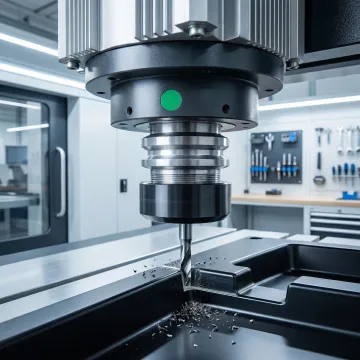
Our in-house fabrication department provides comprehensive secondary operations including precision CNC trimming, drilling, countersinking, heat bending, solvent bonding, mechanical fastening with rivets or screws, threaded insert installation, and edge finishing. We use two 5'x10' CNC trimming centers for primary and secondary trim operations, punch presses, routing machinery, and table saws to finish parts to exact drawing specifications. This allows us to deliver assembly-ready components with minimal post-processing required from your end.
Do you provide design assistance and engineering support?
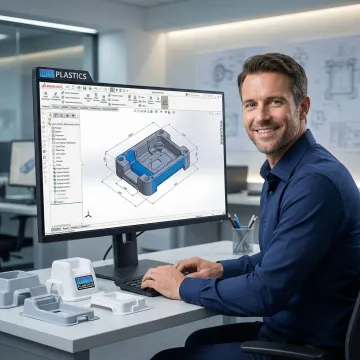
Absolutely. Our sales and engineering team—Brad Hill and Cody Hill—work collaboratively with customers to refine product designs for manufacturability, select appropriate materials, and optimize tooling strategies. We use SolidWorks CAD software to model parts, identify potential molding challenges, and recommend design modifications that improve part quality, reduce tooling costs, or simplify production. Whether you have finished CAD files or just a concept sketch, we provide technical guidance throughout the development process to ensure your project succeeds.
What industries does Hill Plastics serve?
We serve a broad range of industries including aerospace and aviation, telecommunications, medical devices and healthcare, industrial equipment and OEM manufacturing, defense and military, point-of-purchase and retail display, marine, electronics and electrical equipment, oil and gas, and transportation and logistics. Our versatile capabilities, strict quality control, and experience with diverse material and regulatory requirements make us a trusted partner for mission-critical components, custom enclosures, radome housings, machine guards, and specialty fabricated parts across these sectors.
How does Hill Plastics ensure quality throughout the manufacturing process?
We employ a custom quality control system that monitors production progress through all stages—from initial tooling and prototype approval to final CNC trimming and fabrication. Each part is inspected for dimensional accuracy against drawing specifications, appearance standards, and functional requirements. Our experienced staff, many with over 20 years in the industry, apply rigorous attention to detail at every step. We maintain traceability for materials, tooling, and process parameters, ensuring consistent repeatability and compliance with customer specifications and industry standards.