What is thermoforming and how does the process work?
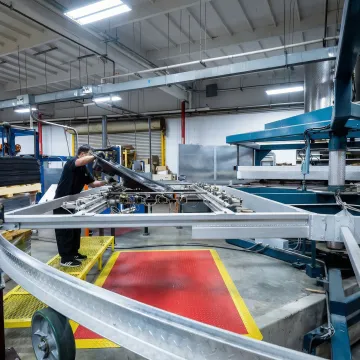
Thermoforming is a manufacturing process where plastic sheets are heated to a specific forming temperature, then shaped over a custom mold using vacuum pressure to remove air between the material and mold surface. At Hill Plastics, we use eight thermoforming machines ranging from 2'x3' to 5'x9', including an advanced 4'x7' rotary system. The process begins with material selection, followed by heating, forming, cooling, and precision CNC trimming to exact specifications, delivering finished parts ready for assembly or installation.
What materials can be used for thermoforming projects?
We work with a comprehensive range of thermoformable plastics including ABS (Acrylonitrile-Butadiene-Styrene), HDPE (High-Density Polyethylene), PETG (Polyethylene Terephthalate Glycol), high-temperature ABS, UV-resistant ASA/ABS compounds, decorative foil-laminated materials, polystyrene, and Kydex. Material selection depends on your application requirements including impact resistance, durability, tensile strength, chemical resistance, temperature tolerance, and environmental exposure. Our engineering team evaluates these factors to recommend the optimal material for cost-effectiveness and performance.
How long does it take to produce thermoformed prototypes?
Prototypes can often be produced within a few weeks depending on design complexity. We use low-cost CNC-milled wood or polyurethane tooling for rapid prototype development, significantly accelerating the timeline compared to production aluminum molds. Once the master pattern is machined to your print specifications and mounted on a mold base, we can quickly form initial prototypes for design review and functional testing. This approach allows for fast iteration—if design changes are needed, modifications to wood patterns are easily accomplished before committing to production tooling.
What is the advantage of using wood tooling for prototypes?
Wood tooling offers three critical advantages for thermoforming prototypes: dramatically lower cost compared to aluminum production molds, much faster fabrication timelines (often weeks instead of months), and easy design modification capability. Our CNC-milled wood or polyurethane master patterns are machined to exact print specifications and serve as functional molds for forming prototypes. If fit, form, or functional testing reveals needed changes, adjustments to wood patterns are straightforward and cost-effective. After prototype approval, the same master pattern is used in the aluminum casting process to create durable production molds.
Can Hill Plastics handle high-volume production runs?
Absolutely. Our facility is equipped for scalable production from short prototype runs to high-volume manufacturing of thousands of parts. We operate a 4'x7' rotary thermoforming machine with cycle times 2.5 times faster than standard single-station equipment, enabling cost-effective high-volume production. Combined with our eight thermoforming machines, over 20,000 square feet of manufacturing space, and 45 years of process expertise, we have the capacity and experience to maintain quality control and competitive pricing across production volumes ranging from prototypes to large-scale OEM manufacturing programs.
What secondary operations and finishing services are available?
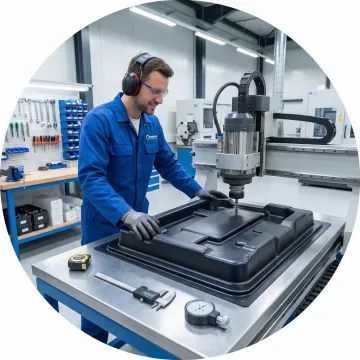
We provide comprehensive secondary operations including precision CNC trimming and cutting, drilling, heat bending, bonding, riveting, fastener installation, threaded insert installation, and edge finishing. Our two 5'x10' CNC trimming centers perform primary and secondary trim operations to exact drawing specifications. Using advanced CNC router equipment, routing machinery, punch presses, and table/panel saws, we deliver assembly-ready parts with clean edges, precise dimensions, and any specified fabrication operations completed. This turnkey capability eliminates the need for multiple vendors and ensures consistent quality from forming through final finishing.
What industries does Hill Plastics serve with thermoforming services?
We serve a diverse range of industries including aerospace and aviation, telecommunications, medical devices and healthcare, industrial equipment and OEM manufacturers, defense and military, point-of-purchase and retail display, marine, electronics and electrical equipment, oil and gas/energy, and transportation and logistics equipment. Our applications span custom enclosures, radome enclosures for telecommunications, material handling trays, POP displays, custom OEM parts, machine guards, industrial components, automotive parts, and medical device housings. Our engineering team understands the specific requirements and regulatory considerations for each industry sector.
How does Hill Plastics ensure quality control throughout production?
Quality control is integrated throughout our entire manufacturing process. We use a custom quality control system that monitors production progress through all stages—from material selection and tooling validation through forming, trimming, and finishing operations. Each production part is inspected for appearance quality and conformance to print specifications and dimensional tolerances. Our SolidWorks CAD software ensures accurate design-to-manufacturing translation, while our experienced staff (with minimum tenure averaging 20 years) applies process expertise to maintain consistent part quality. Competitive pricing is achieved without compromising the precision and reliability our aerospace, medical, and industrial clients require.