What materials can Hill Plastics thermoform for Georgia projects?
We work with a comprehensive range of thermoplastic sheet materials including ABS (standard and high-temperature), HDPE, PETG, UV-resistant ASA/ABS, Kydex, polystyrene, and decorative foil-laminated plastics. Our engineering team evaluates your application requirements—impact resistance, chemical exposure, temperature range, UV stability, and regulatory compliance—to recommend the optimal material. We maintain inventory of common grades and can source specialty formulations for aerospace, medical device, food contact, and marine applications serving Georgia manufacturers.
How quickly can Hill Plastics produce thermoformed prototypes?
Prototype turnaround depends on part complexity and tooling requirements, but we typically deliver initial samples within 2-4 weeks. Our low-cost wood or polyurethane master patterns can be CNC-milled and mounted quickly, enabling rapid iteration cycles. For Georgia clients on urgent development schedules, we prioritize prototype tooling and can often expedite simple geometries. Once you approve the prototype, we transition to aluminum production molds while maintaining the exact dimensional specifications verified during your testing phase.
What is the difference between vacuum forming and heavy gauge thermoforming?
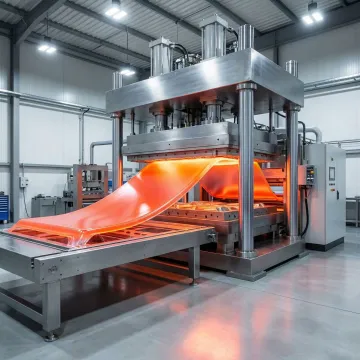
Both processes heat plastic sheet and form it over a mold using vacuum pressure, but heavy gauge thermoforming uses thicker materials (typically 0.120" and above) for structural parts requiring rigidity and impact resistance—such as industrial enclosures, equipment housings, and protective covers. Standard vacuum forming uses thinner gauge materials for applications like packaging, trays, and point-of-purchase displays. Hill Plastics operates equipment capable of forming materials from thin gauge up to heavy structural sheets on presses ranging from 2'x3' to 5'x9', serving diverse Georgia industry needs.
Does Hill Plastics offer secondary operations beyond thermoforming?
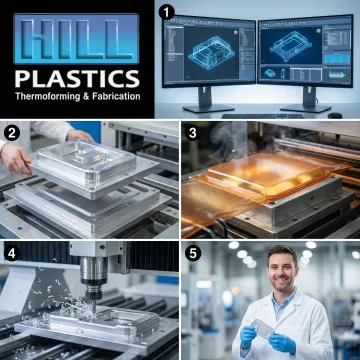
Yes, our full-service fabrication capabilities include CNC trimming on dual 5'x10' centers, precision drilling, heat bending, ultrasonic welding, adhesive bonding, mechanical fastener installation (rivets, threaded inserts), edge finishing, silk screening, and assembly operations. We deliver inspection-ready, finished parts rather than requiring Georgia customers to coordinate multiple vendors. Our SolidWorks-driven CNC programming ensures dimensional accuracy for complex contours, cutouts, and fastener locations, with repeatable quality across production runs from prototypes through thousands of units.
What size parts can Hill Plastics thermoform?
Our eight thermoforming machines accommodate parts from small 2'x3' components up to large 5'x9' assemblies. Our newest 4'x7' rotary thermoforming press handles high-volume mid-size parts with exceptional efficiency—running 2.5 times faster than standard single-station equipment. For Georgia projects requiring larger dimensions, we can often design multi-piece assemblies with precision joint details. During the design consultation phase, our engineering team will recommend optimal part segmentation and tooling strategies to balance size constraints, structural requirements, and production economics.
How does Hill Plastics ensure quality control for production runs?
We implement a custom quality control system that monitors parts through every production stage—from raw material verification and forming temperature control through dimensional inspection after CNC trimming. Each production run is checked against your print specifications using calibrated measurement tools, and visual appearance is inspected for surface defects, color consistency, and finish quality. For Georgia aerospace, medical, and industrial customers requiring documentation, we provide inspection reports, material certifications, and traceability records. Our experienced production staff—many with 20+ years tenure—maintain rigorous standards throughout manufacturing.
What industries does Hill Plastics serve in Georgia?
We manufacture thermoformed components for Georgia's aerospace and aviation sector (radomes, interior panels, equipment housings), telecommunications infrastructure (antenna enclosures, junction boxes), medical devices and healthcare equipment (diagnostic housings, sterilizable trays), industrial OEM manufacturers (machine guards, control enclosures), defense and military applications, point-of-purchase retail displays, marine equipment, electronics enclosures, oil and gas components, and transportation systems. Our 45 years of cross-industry experience means we understand diverse regulatory requirements, performance standards, and application environments relevant to Georgia manufacturers.
Can Hill Plastics help with design optimization for thermoforming?
Absolutely. Our sales and engineering team—Brad Hill and Cody Hill—provide expert design assistance to optimize part geometry for the thermoforming process. We review your CAD files or concepts to recommend draft angles, corner radii, wall thickness distributions, rib placements, and undercut solutions that enhance formability, reduce tooling cost, and improve structural performance. For Georgia startups and product development teams, we offer turnkey support from initial sketches through production-ready designs, material selection, tooling strategy, and manufacturing execution—ensuring your vision becomes a cost-effective, manufacturable reality.