What is thermoforming and how does it work?
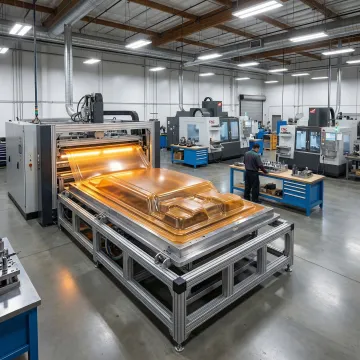
Thermoforming is a manufacturing process where plastic sheet material is heated to a specific forming temperature until pliable, then formed over or into a mold using vacuum pressure. Air is removed between the mold and material, drawing the heated plastic into the mold's shape. Once cooled, the formed part is trimmed to specifications using CNC equipment, routing machinery, or punch presses. This process is ideal for producing custom enclosures, radome covers, industrial components, and display fixtures in low to high volumes with significantly lower tooling costs than injection molding.
What materials can be thermoformed?
We work with a comprehensive range of thermoplastic materials including ABS (Acrylonitrile-Butadiene-Styrene), HDPE (High-Density Polyethylene), PETG (Polyethylene Terephthalate Glycol), high-temperature ABS, UV-resistant ASA/ABS, decorative foil-laminated materials, polystyrene, and Kydex. Material selection depends on your application's requirements including impact resistance, chemical exposure, temperature tolerance, UV stability, durability, and cost considerations. Our engineering team evaluates these factors to recommend the optimal material for your specific product and operating environment.
How long does it take to produce thermoformed prototypes?
Prototype turnaround depends on design complexity, but we typically produce master patterns and initial prototypes within a few weeks. We use low-cost CNC-milled wood or polyurethane tooling for prototyping, which can be manufactured much faster than production aluminum molds. This approach allows rapid design validation and functional testing. If design modifications are needed after initial prototypes, changes can be made quickly to the wood pattern before committing to production tooling. Once approved, production aluminum tooling is created using the validated master pattern.
What industries do you serve with thermoforming services?
We serve a diverse range of industries including aerospace and aviation, telecommunications, medical devices and healthcare, industrial equipment and OEM manufacturers, defense and military, point-of-purchase and retail display, marine, electronics and electrical equipment, oil and gas energy, and transportation and logistics equipment. Our 45 years of experience and quality control systems have earned the confidence of engineers and purchasing agents across these sectors for applications ranging from aircraft interior components and medical equipment housings to telecommunication radome enclosures and industrial machine guards.
What are the advantages of thermoforming over injection molding?
Thermoforming offers several key advantages: significantly lower tooling costs, especially for large parts where injection mold tooling can be prohibitively expensive; faster time to market with prototype tooling often ready in weeks rather than months; greater design flexibility during development with easy modifications to wood patterns; and cost-effectiveness for low to medium production volumes. Large parts can be manufactured at reasonable costs relative to size. For prototyping and short production runs, thermoforming provides an economical alternative while still delivering precision parts to exact specifications.
What is your production capacity for high-volume orders?
We have substantial high-volume production capabilities with eight thermoforming machines ranging from 2'x3' to 5'x9', including a 4'x7' rotary thermoforming machine with cycle times 2.5 times faster than standard single-station equipment. Our 20,000+ square-foot facility and experienced staff support production runs from prototyping and short batches to large-volume orders of thousands of parts. All production parts undergo quality control inspection for appearance and dimensional accuracy against print specifications, with competitive pricing maintained across volume levels.
Do you offer secondary operations and finishing services?
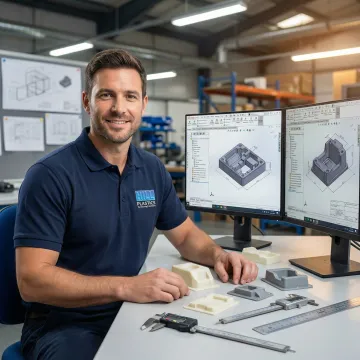
Yes, we provide comprehensive secondary operations and finishing through our skilled fabrication department and advanced CNC equipment. Services include precision CNC trimming and cutting using two 5'x10' trimming centers, precision drilling and fastener preparation, heat bending for complex geometries, bonding and assembly, riveting and threaded insert installation, and edge finishing. We also offer custom fabrication for POP displays, machine guards, and industrial components. Our SolidWorks design integration ensures all secondary operations meet exact drawing specifications for turnkey delivery.
What geographic areas do you serve?
While we're headquartered in Lewisville, Texas near Dallas/DFW, we serve customers throughout Michigan and across the entire United States. Our decades of experience working with OEM manufacturers, aerospace companies, telecommunications providers, medical device firms, and industrial clients nationwide has established us as a trusted partner regardless of location. We provide full project support from design consultation and prototyping through production and fulfillment, with efficient logistics for delivering finished parts to your facility or end-use location.