What is thermoforming and how does it differ from injection molding?
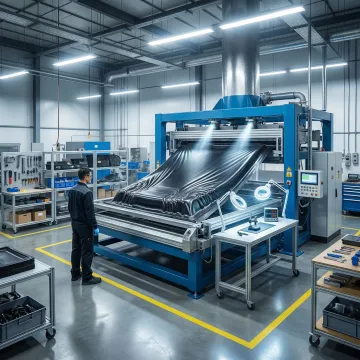
Thermoforming heats flat plastic sheets to a forming temperature, then shapes them over a mold using vacuum pressure or mechanical force. Unlike injection molding, which requires expensive steel molds and high setup costs, thermoforming uses lower-cost tooling—often CNC-milled wood or polyurethane for prototypes and aluminum castings for production. This makes thermoforming ideal for medium to large parts, shorter production runs, and projects requiring rapid design iteration. The process excels at producing enclosures, panels, trays, and custom housings with excellent surface finish and dimensional accuracy.
What materials can be thermoformed, and how do I choose the right one?
Hill Plastics forms ABS, HDPE, PETG, polystyrene, KYDEX, high-temperature ABS, UV-resistant ASA/ABS, and decorative foil-laminated sheets. Material selection depends on your application's impact requirements, chemical resistance, temperature exposure, and environmental conditions. For example, PETG offers clarity and chemical resistance for medical applications, while ASA/ABS withstands outdoor UV exposure for telecommunications radomes. Our engineering team evaluates your part's functional demands—tensile strength, durability, cost constraints—and recommends the optimal material to balance performance and budget.
How long does it take to produce thermoformed prototypes?
Prototypes can typically be delivered in just a few weeks, depending on part complexity and tooling requirements. Hill Plastics uses low-cost wood or polyurethane master patterns CNC-milled to your exact specifications, which are mounted on mold bases for vacuum forming test parts. This approach allows you to evaluate fit, function, and design quickly. If adjustments are needed, changes to the wood pattern are straightforward and economical. Once prototypes are approved, we transition seamlessly to aluminum production tooling for high-volume manufacturing, minimizing time from concept to market.
What industries does Hill Plastics serve with thermoforming services?
We've served aerospace, telecommunications, medical devices, industrial equipment, defense, marine, electronics, oil and gas, transportation, and point-of-purchase display sectors since 1977. Our thermoformed components include radome enclosures for cell towers, custom trays for material handling, medical device housings meeting regulatory standards, aircraft interior panels, machine guards, and retail displays. Each industry has unique material and precision requirements, and our 45 years of experience across diverse applications gives us the expertise to deliver compliant, high-quality parts for demanding environments.
Can Hill Plastics handle both small prototype runs and large-scale production?
Absolutely. Our facility is equipped for prototype-to-production scalability. For prototypes and short runs, we use low-cost wood or polyurethane tooling on our eight thermoforming machines (sizes 2'x3' to 5'x9'). For high-volume production, our 4'x7' rotary thermoforming machine delivers cycle times 2.5 times faster than standard single-station equipment, enabling cost-effective manufacturing of thousands of parts. With over 20,000 square feet of manufacturing space, CNC trimming centers, and experienced staff, we efficiently manage projects from single prototypes to sustained large-volume orders.
What secondary operations can be performed on thermoformed parts?
Hill Plastics offers comprehensive secondary fabrication: precision CNC trimming and routing to exact drawing specifications, drilling for fasteners and assembly, heat bending for compound curves, bonding and welding of multi-piece assemblies, riveting, threaded insert installation, and edge finishing. Our two 5'x10' CNC trimming centers ensure repeatable accuracy for complex geometries. These operations transform raw thermoformed parts into assembly-ready components, reducing your need for multiple vendors and streamlining production timelines while maintaining tight tolerances and quality control throughout.
How does Hill Plastics ensure quality and precision in production parts?
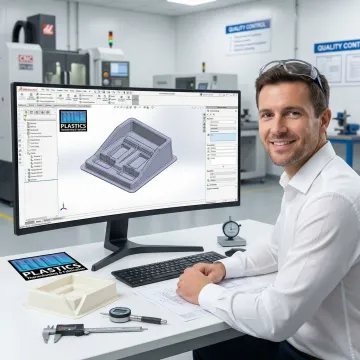
We employ a custom quality control system that monitors production progress through all manufacturing stages—from initial forming and CNC trimming to secondary operations and final inspection. Parts are checked against drawing specifications for dimensional accuracy, surface finish, and functional fit. Our SolidWorks-driven CNC programming ensures repeatability, and our experienced staff (many with 20+ years tenure) applies rigorous process discipline. For aerospace, medical, and industrial OEM clients, this multi-stage QC approach delivers consistent, specification-compliant parts batch after batch, backed by competitive pricing and on-time delivery.
What are the cost advantages of thermoforming over other plastic manufacturing methods?
Thermoforming offers significantly lower tooling costs compared to injection molding—often 50-80% less—because molds are simpler and made from aluminum, wood, or polyurethane rather than hardened steel. Prototyping is fast and affordable, allowing design validation before production investment. Large parts and enclosures that would be prohibitively expensive in injection molding are cost-effective with thermoforming. The process also supports economical short to medium production runs (100-10,000 parts), making it ideal for custom applications, rapid product development, and markets requiring flexibility without sacrificing quality or precision.