Introduction
Engineers and product developers face a critical decision when selecting a plastic manufacturing process for their next project. Both injection molding and vacuum forming use heat and molds to create plastic parts, yet they serve fundamentally different production needs. Choose the wrong process and you risk paying for tooling you didn't need, waiting months longer than necessary, or building parts that fall short of spec.
The cost and time gaps between these two processes are significant:
- Tooling cost: Injection molding runs $25,000–$100,000+; vacuum forming typically $1,000–$30,000
- Lead time: Injection molds take 8–20+ weeks; vacuum forming tools are ready in 1–8 weeks
This guide breaks down both processes across cost, complexity, volume, and application — so you can pick the right one before committing your budget.
Key Takeaways
- Injection molding injects molten plastic pellets under pressure into a closed mold; vacuum forming stretches heated plastic sheets over a mold using atmospheric pressure
- Vacuum forming is faster to set up and better suited for large, simple parts at lower volumes (under 3,000–5,000 units); injection molding wins at high volumes (5,000+) with complex geometries and tight tolerances (±0.05mm)
- Tooling costs differ sharply: injection molding runs $25,000–$100,000+, while vacuum forming tooling starts as low as $1,000–$30,000
- The right choice depends on production volume, part complexity, size, tolerances, and budget
- Vacuum forming is often the better entry point for new product development requiring design iteration
Injection Molding vs. Vacuum Forming: Quick Comparison
Tooling Cost
Tooling is where these two processes diverge most sharply on cost. Injection molds must withstand internal pressures of 10,000–20,000 psi and are machined from hardened steel, which drives up expense at every tier:
| Mold Type | Injection Molding | Vacuum Forming |
|---|---|---|
| Prototype (wood, 3D printed, urethane) | $3,000–$8,000 | $1,000–$10,000 |
| Medium-complexity steel/aluminum | $8,000–$25,000 | $4,000–$30,000 |
| High-precision multi-cavity production | $100,000+ | N/A |
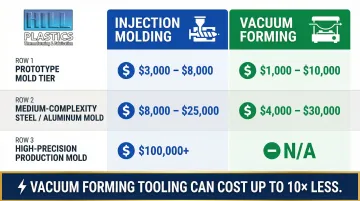
Vacuum forming uses single-sided molds that only need to handle atmospheric pressure (~14.7 psi), keeping tooling costs significantly lower across the board.
Production Volume
Injection Molding: Best suited for high-volume production runs, typically above 3,000-5,000 units annually. At this threshold, manufacturers amortize the upfront tooling investment across enough parts to achieve per-part costs that outcompete vacuum forming.
Vacuum Forming: Most cost-effective below the 3,000-5,000 unit threshold. However, for very large parts requiring massive injection molding presses (3,000+ tons), vacuum forming can maintain a cost advantage even at volumes exceeding 10,000 units annually.
Design Complexity
Injection Molding: The closed-mold process supports intricate internal geometries — undercuts, threads, ribs, bosses, and snap fits — with typical tolerances of ±0.05mm to ±0.5mm per ISO 20457 and DIN 16742 standards.
Vacuum Forming: Best for simpler, shallower shapes without deep internal cavities. The process is limited to forming in one direction, with typical tolerances of ±0.020" for formed dimensions up to 12 inches. Wall thickness varies due to sheet stretching, particularly in corners and deep-draw areas.
Lead Time
Injection Molding: Longer development timelines are standard. Prototype or bridge molds require 2-10 weeks, while production-grade steel molds typically take 8-20+ weeks from design to first article. Any design modifications require expensive and time-consuming mold rework.
Vacuum Forming: Significantly faster turnaround. Prototype tooling using 3D-printed or wood molds can be ready in days to 2 weeks, while production aluminum tooling takes 1-8 weeks. This speed advantage makes vacuum forming ideal for rapid iteration and bridge production.
Part Size
Injection Molding: Better for smaller, detailed parts. Maximum part size is governed by clamping force (Force = Pressure × Projected Area), platen dimensions, and shot weight capacity. Very large parts require presses exceeding 3,000 tons for macro-components.
Vacuum Forming: Excellent for large-format parts, with capabilities extending up to 9' × 12' sheet sizes. Since forming relies on atmospheric pressure rather than machine tonnage, scaling to larger parts doesn't require exponentially more expensive equipment.
What is Injection Molding?
Injection molding is a manufacturing process where plastic pellets or granules are melted in a heated barrel and injected under high pressure (typically 10,000–20,000 psi) into a precisely machined closed mold cavity. After the part cools and solidifies, the mold opens and ejector pins push out the finished component.
This cycle-based approach makes injection molding the dominant choice for high-precision, high-volume plastic parts across industries.
Key operational advantages include:
- High repeatability and consistency across large production batches
- Tight tolerances (±0.05mm to ±0.5mm) enable precision assembly
- Complex features like threads, bosses, snap fits, and inserts can be molded directly into the part
- Multi-material molding allows combining different plastics or colors in a single part
Injection molding supports a wide range of materials: thermoplastics (PP, PE, ABS, PC, Nylon), thermosets, thermoplastic elastomers (TPEs), and glass-filled or fiber-reinforced polymers. For example, 30% glass-filled nylon can triple tensile strength and quadruple stiffness compared to unfilled resin — giving engineers precise control over mechanical, chemical, and thermal performance.
That capability comes with real cost. Tooling runs $25,000–$100,000+ and lead times to first part typically span 8–20 weeks — making injection molding a poor fit for prototypes, short runs, or designs that may change. Once a steel tool is cut, modifications are expensive and slow.
Use Cases of Injection Molding
Injection molding dominates industries and products requiring complexity and volume:
- Consumer electronics housings for smartphones, remote controls, and device enclosures
- Automotive interior components including dashboards, trim panels, and under-hood connectors
- Medical device enclosures such as syringes, surgical tools, and biocompatible housings using PP, PC, and PEEK
- Threaded fasteners and small precision components requiring tight tolerances and repeatable quality
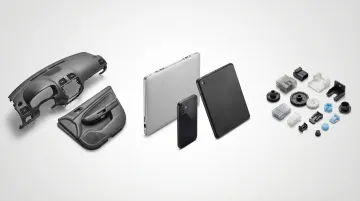
The process becomes less practical for very large parts. As part projected area grows, required clamping force scales proportionally, demanding much larger and more expensive machines. A part requiring 3,000+ tons of clamping force necessitates massive presses with hourly rates that quickly erode cost advantages.
What is Vacuum Forming?
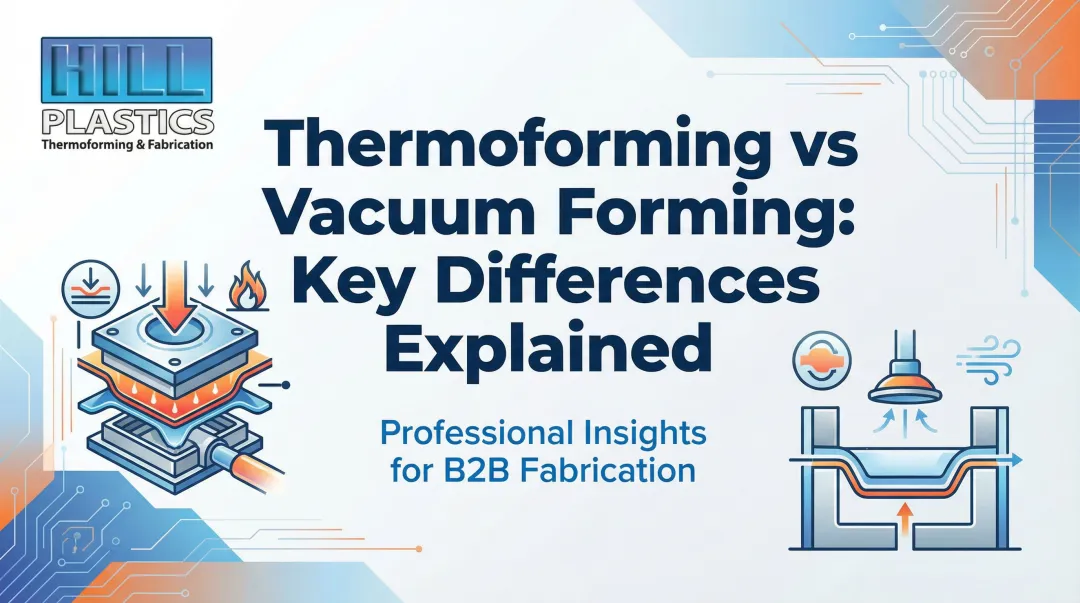
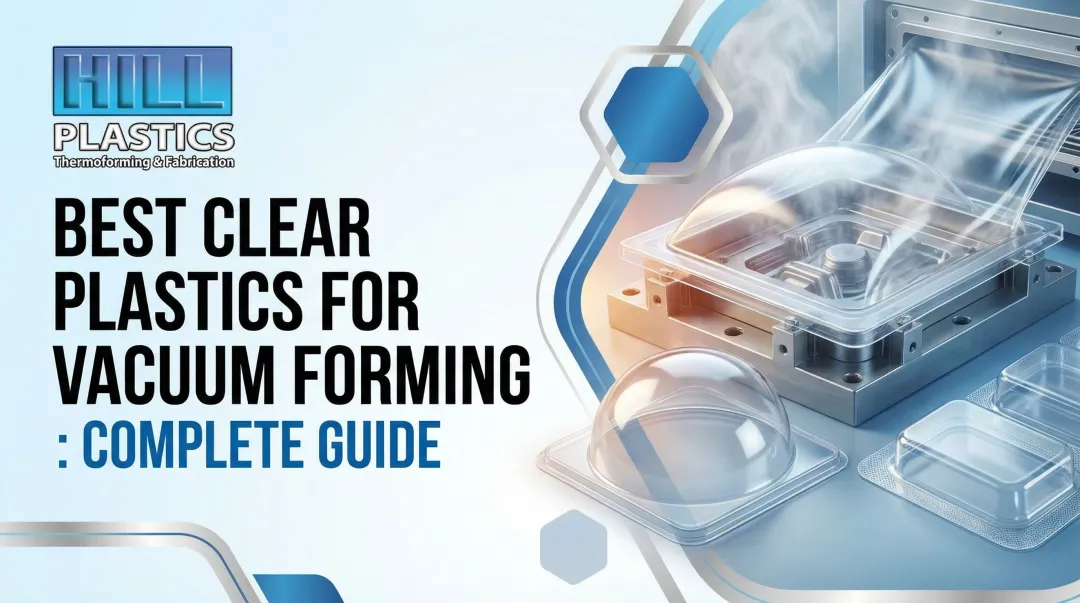
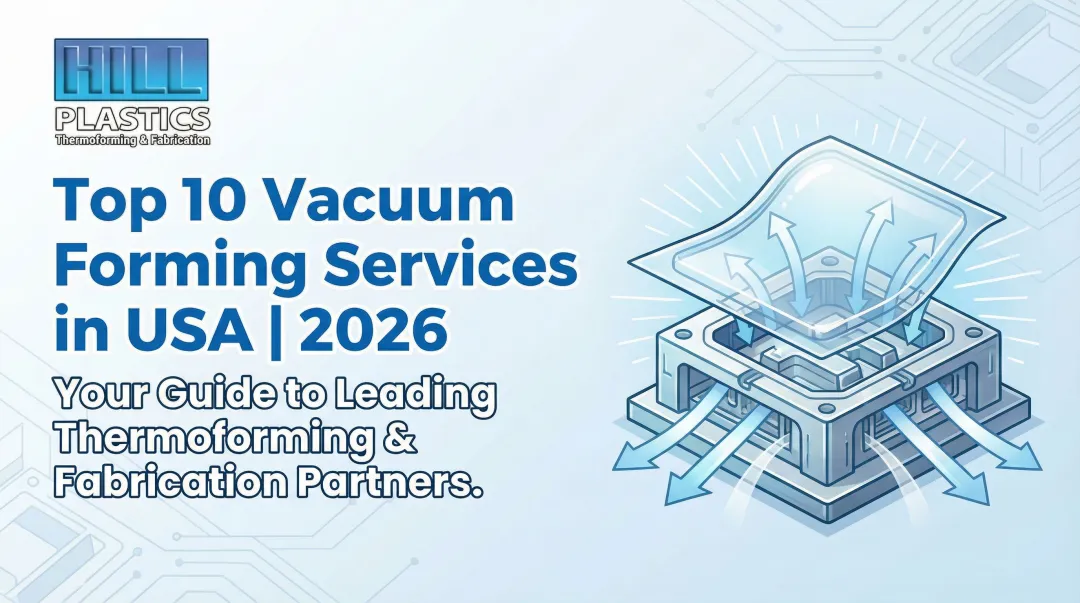
Vacuum forming is a thermoforming process where a flat thermoplastic sheet is clamped in a frame, heated until pliable (typically 150-180°C for materials like ABS), then stretched over a single-surface mold. Vacuum pressure—created by removing air between the sheet and mold—pulls the material tightly into shape using atmospheric pressure (~14.7 psi). After cooling, the part is trimmed to final dimensions using CNC routers or die cutting.
This simpler process translates to tangible advantages:
- Low-cost tooling: Molds can be made from wood, polyurethane, or aluminum at a fraction of injection molding tool costs
- Fast design iteration: Changes to wood or urethane molds are quick and inexpensive
- Large-part capability: Sheet sizes up to 9' × 12' enable forming very large components without massive equipment investment
- Shorter time to first part: Production tools ready in 1-8 weeks versus 8-20+ weeks for injection molds
Vacuum forming shapes material in one direction only, which limits geometric complexity. Wall thickness varies due to sheet stretching—corners and deep recesses thin out significantly based on draw ratio. Tolerances typically hold to ±0.020", compared to ±0.002" achievable with injection molding.
Material options are limited to thermoplastic sheets: ABS, PETG, HIPS, HDPE, PP, PVC, and specialty variants like UV-stable or conductive grades. Sheet-based forming allows surface finishes and textures to be incorporated at the material level—including glossy, matte, or textured surfaces.
Use Cases of Vacuum Forming
Vacuum forming is particularly well-suited for specific industries and products:
- Large enclosures for industrial equipment, electrical housings, and protective covers
- Radomes for telecommunications requiring low-dielectric materials that don't attenuate RF signals
- Aerospace interior panels including cabin liners, overhead bins, and seating components using FST-compliant materials
- Marine parts such as boat consoles, dash panels, and equipment housings
- Medical equipment housings and custom trays for healthcare applications
- Industrial covers and machine guards for manufacturing environments
- Packaging and point-of-purchase displays
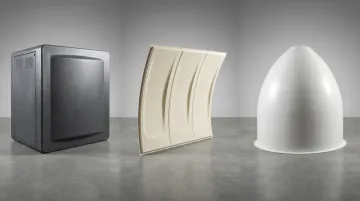
The prototyping advantage is significant: vacuum forming allows engineers and entrepreneurs to validate designs quickly and cost-effectively before committing to injection molding tooling. Prototype molds in wood or polyurethane can be ready in days to weeks—giving teams a functional part in hand while injection mold tooling is still being quoted.
Hill Plastics has specialized in vacuum forming since 1977, running eight thermoforming machines (2'×3' to 5'×9') and a 4'×7' rotary machine built for high-volume runs. That depth of experience across aerospace, telecommunications, medical, and industrial OEM work is what makes the process tradeoffs—versus injection molding—worth understanding clearly before choosing a manufacturing path.
Injection Molding vs. Vacuum Forming: Which One Should You Choose?
The decision hinges on five key variables: production volume, part complexity, part size, required tolerances, and project budget. No single process is universally better; each fits specific scenarios well.
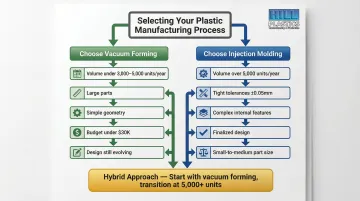
Choose injection molding when:
- Production volumes exceed 5,000 units annually, where per-part savings offset tooling investment
- Parts require intricate internal features, undercuts, threads, or multi-material molding
- Tight tolerances (±0.05mm to ±0.5mm) are essential for assembly or function
- Design is finalized with minimal expected changes
- Part size is small to medium (avoiding massive tonnage requirements)
Choose vacuum forming when:
- Production volumes are under 3,000-5,000 units annually
- Parts are large (reducing injection molding's economic advantage)
- Parts are relatively simple geometrically without complex internal features
- Tooling budget is constrained (under $30,000)
- Design iteration is likely during product development
- Time-to-market is critical (need parts in weeks, not months)
The hybrid approach is common and practical: begin with vacuum forming for prototyping and initial production runs, then transition to injection molding once volumes grow and design is locked in. A good trigger point: once annual volume crosses 5,000 units and engineering sign-off is complete, the tooling investment for injection molding typically pays back within the first production year.
If vacuum forming fits your project profile, Hill Plastics' engineering team — Brad Hill and Cody Hill — can evaluate your part design and production requirements. They assist with material selection, tooling recommendations, and CAD review to confirm the design is production-ready. Contact Hill Plastics at 972-436-9717 or email sales@hillplastics.com to discuss your project.
Real-World Application Examples
Understanding the cost dynamics requires concrete scenarios. SSI Custom Plastics published a detailed breakeven analysis comparing total cost of ownership over a 3-year product lifecycle:
Low-Volume Scenario (Belt Guard, 200 parts/year):
- Vacuum forming: $2,200 tooling + $46.80/part = $30,280 total (3 years)
- Injection molding: $28,000 tooling + $29.88/part = $45,928 total (3 years)
- Result: Vacuum forming saves $15,648 (34% cost reduction)
High-Volume Scenario (Serving Spoons, 30,000 parts/year):
- Vacuum forming: $2,500 tooling + $2.80/part = $254,000 total (3 years)
- Injection molding: $52,000 tooling + $0.28/part = $77,200 total (3 years)
- Result: Injection molding saves $176,800 (70% cost reduction)
The crossover point here sits somewhere between 200 and 30,000 parts per year — meaning process selection is essentially a math problem once you know your annual volume and per-part targets.

Telecommunications Radome Manufacturing
Thermoforming is the preferred process for telecommunications radomes — it sidesteps the high tooling costs of injection molding for large dome geometries while preserving RF transparency. Materials like Boltaron 4550 offer low dielectric constants (2.91 at 2.5 GHz) and minimal water absorption, both critical for limiting signal attenuation.
The production speed advantage is real. Hagans Plastics deep-draw thermoformed a 15.5" diameter × 25" tall ABS radome, delivering 150 pieces in six weeks — a timeline injection molding tooling alone couldn't match. Hill Plastics serves major telecom clients including CommScope and Antenna Products with comparable radome solutions.
Aerospace Interior Panels
Aircraft cabin liners must meet strict Flammability, Smoke, and Toxicity (FST) certification — and vacuum forming is well-suited to these large-format components because it covers entire panels in a single step without secondary upholstery operations. A 2024 technical assessment confirmed that vacuum-formed ABS/polyurethane foam sandwich panels offer a lighter, more economical alternative to compression-molded fiberglass for non-structural cabin interiors.
Across all three scenarios — cost breakevens, radomes, and aircraft panels — the pattern holds: vacuum forming wins on tooling economics and large-format flexibility, while injection molding earns its place at scale. Knowing where your project falls on that spectrum is the practical starting point for any process decision.
Conclusion
Injection molding and vacuum forming each have clear strengths—there's no universal winner. Injection molding delivers precision, complexity, and low per-part cost at scale; vacuum forming delivers lower tooling investment, faster setup, large-part capability, and flexibility for design iteration.
For OEM manufacturers, entrepreneurs, and engineers evaluating a new plastic part, matching the process to production volume, part geometry, and budget is the most important decision. A common path: start with vacuum forming for prototypes, then transition to injection molding once volumes justify the tooling investment.
As a quick reference:
- Choose vacuum forming when tooling budgets are limited, parts are large, or designs are still evolving
- Choose injection molding when volumes are high, tolerances are tight, and the design is finalized
- Consider a hybrid approach when early-stage prototypes need to reach market fast before committing to hard tooling
Hill Plastics has been helping OEM manufacturers navigate these decisions since 1977—with low-cost prototype tooling, eight thermoforming machines, and a team that can guide you from first sketch to finished part.
Frequently Asked Questions
What is the difference between injection molding and vacuum forming?
Injection molding melts plastic pellets and injects them under high pressure (10,000-20,000 psi) into a closed steel mold, producing high-precision complex parts with tight tolerances. Vacuum forming heats a plastic sheet and uses atmospheric pressure (~14.7 psi) to shape it over a single-sided mold—best for simpler, larger parts at lower volumes with faster tooling turnaround.
What are the four types of molding?
The four common plastic molding types are injection molding (molten plastic injected into closed molds for precision parts), blow molding (compressed air shapes hollow parts like bottles), compression molding (thermosetting resin pressed between heated mold halves), and rotational molding (material rotated in heated molds to create large hollow parts like tanks).
Is vacuum forming cheaper than injection molding?
Yes, for low-to-medium volumes. Vacuum forming has significantly lower upfront tooling costs ($1,000-$30,000 vs. $25,000-$100,000+), making it cheaper for prototyping and runs under 3,000-5,000 units. Injection molding becomes more cost-effective per part at high volumes (5,000+ units) once tooling costs are amortized across larger production quantities.
What industries commonly use vacuum forming?
Aerospace, telecommunications, marine, medical, automotive, and industrial manufacturing rely heavily on vacuum forming. It's especially prevalent for large enclosures, radomes, equipment panels, protective housings, custom trays, and interior components where tooling cost, part size, and design flexibility outweigh the need for extreme precision.
Can vacuum forming be used for prototyping?
Yes. Vacuum forming is a strong prototyping option — low tooling costs ($1,000-$10,000 for wood/urethane molds), fast lead times (1-8 weeks), and easy design changes make it practical for validating geometry and fit before committing to expensive injection mold tooling.
What is the typical production volume threshold for choosing injection molding over vacuum forming?
The crossover point is generally around 3,000-5,000 units annually, though it varies based on part size, complexity, and tooling cost. For very large parts requiring massive injection molding presses (3,000+ tons), vacuum forming often remains the better choice even at higher quantities due to equipment cost differences.